MOQ in Ayurvedic Third Party Manufacturing: What Does It Mean?
If you are planning to launch Ayurvedic products through third party manufacturing, one of the first commercial terms you are likely to encounter is MOQ. MOQ stands for Minimum Order Quantity. It refers to the minimum quantity that a manufacturer may require for a particular product or production order.
Understanding MOQ is important because it can affect your initial investment, inventory planning, packaging, product selection, cash flow and overall business strategy. The right MOQ depends on several factors, including the product format, formulation, packaging, artwork, production requirements and the manufacturer's commercial terms.
- Introduction
- What Is MOQ?
- MOQ in Ayurvedic Third Party Manufacturing
- Why MOQ Matters
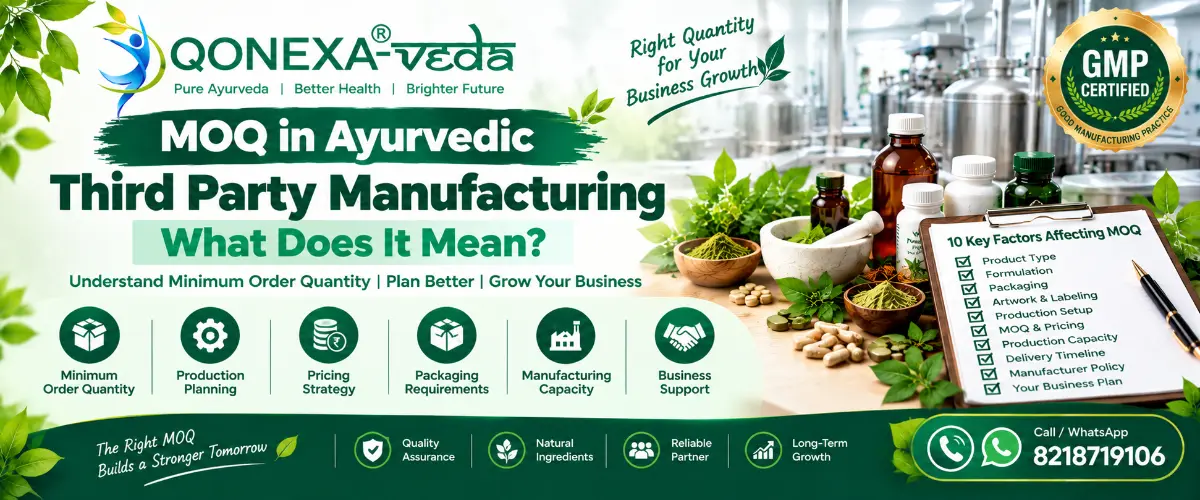
- Factors That Affect MOQ
- Product Type and MOQ
- Packaging and MOQ
- Custom Formulation and MOQ
- Private Label and MOQ
- MOQ and Product Pricing
- How MOQ Affects Investment
- MOQ for New Businesses
- Questions to Ask a Manufacturer
- Common MOQ Mistakes
- How to Plan Your Order
- MOQ Checklist
- Qonexa Veda
- Frequently Asked Questions
Introduction to MOQ in Ayurvedic Third Party Manufacturing
Ayurvedic third party manufacturing allows businesses to work with a manufacturer to produce Ayurvedic or herbal products without necessarily operating their own manufacturing facility.
For entrepreneurs, distributors, PCD franchise owners and private label businesses, this model can provide a practical way to develop and supply a product portfolio. However, before placing an order, it is important to understand the manufacturer's commercial conditions.
Among these conditions, MOQ is particularly important. A manufacturer may specify a minimum number of units, boxes, bottles, cartons or other production quantities for a particular product.
If a manufacturer specifies an MOQ of 1,000 units for a particular product, the order may need to meet or exceed that quantity. The actual MOQ can vary from one product and manufacturer to another.
What Is MOQ?
MOQ means Minimum Order Quantity. It is the minimum quantity of a product that a manufacturer may accept for a particular manufacturing order.
For example, suppose you want to manufacture an Ayurvedic syrup. The manufacturer may quote a minimum quantity based on production requirements, bottle size, packaging, filling process and other factors.
MOQ is not necessarily the same for every product. A tablet, capsule, syrup, oil or powder may have different manufacturing and packaging requirements, which can result in different minimum quantities.
MOQ Can Be Expressed As
- Number of units
- Number of bottles
- Number of boxes
- Number of cartons
- Batch quantity
- Production weight or volume
Always ask the manufacturer how the MOQ is calculated for your specific product.
What Does MOQ Mean in Ayurvedic Third Party Manufacturing?
In Ayurvedic Third Party Manufacturing, MOQ generally represents the minimum production quantity agreed between the business and the manufacturing company.
The MOQ may depend on the formulation, production batch, packaging material, printing requirements and other manufacturing considerations.
For a new business, MOQ is particularly important because ordering too much inventory can tie up capital, while ordering too little may not satisfy the manufacturer's minimum production requirement.
Product MOQ
Minimum number of finished units required for the product order.
Packaging MOQ
Minimum quantity required for customized bottles, boxes, labels or other packaging components.
Batch MOQ
Minimum production batch determined by manufacturing requirements.
Custom MOQ
A different minimum may apply when custom formulations or customized requirements are involved.
Why Is MOQ Important?
Understanding MOQ before placing an order can help you plan your business more effectively. It provides an idea of how much inventory you may need to purchase at one time.
MOQ Can Affect:
- Initial investment
- Inventory levels
- Storage requirements
- Cash flow
- Packaging costs
- Product selection
- Launch planning
- Repeat ordering
For this reason, MOQ should be discussed before you finalize products, packaging and commercial terms.
Factors That Affect Ayurvedic Third Party Manufacturing MOQ
There is no universal MOQ that applies to every Ayurvedic product. Several factors can influence the minimum quantity.
1. Product Type
Different dosage forms can have different production and packaging requirements.
2. Formulation
Custom or specialized formulations may involve different production considerations.
3. Packaging
Customized packaging and printing can influence minimum quantities.
4. Artwork
Private label artwork and printed packaging may require specific production quantities.
5. Production Setup
Manufacturing setup and batch requirements can affect the minimum order.
6. Manufacturer Policy
Each manufacturer may have its own commercial MOQ policy.
How Product Type Can Affect MOQ
Product format is one of the factors you should discuss with your manufacturer. Different formats may require different equipment, production processes and packaging materials.
| Product Format | Possible MOQ Considerations |
|---|---|
| Tablets | Batch production, tablet specifications and packaging. |
| Capsules | Capsule size, formulation, batch and packaging requirements. |
| Syrups | Liquid production, bottle size, filling and labeling. |
| Oils | Oil formulation, bottle/container and packaging requirements. |
| Powders | Batch size, filling quantity and packaging format. |
These are general considerations only. The actual MOQ should always be confirmed directly with the manufacturer for the specific product.
How Packaging Can Affect MOQ
Packaging is an important part of Ayurvedic third party manufacturing. If you choose standard packaging, the manufacturer's existing production system may offer one set of commercial conditions. Customized packaging may have different requirements.
Customized Packaging Can Include
- Custom printed boxes
- Custom labels
- Printed bottles or containers
- Special pack sizes
- Customized cartons
- Brand-specific artwork
Before approving artwork, ask about packaging MOQ separately from product MOQ. This helps you understand the total order requirement.
Custom Formulation and MOQ
Businesses sometimes want a formulation or product specification that is different from a manufacturer's existing catalogue. In such cases, the commercial and production requirements may differ from standard products.
Custom formulation can involve additional development, raw material, production, testing, documentation or packaging considerations, depending on the project.
Before Choosing a Custom Product, Ask:
- Is the formulation already available?
- What is the minimum batch requirement?
- Are special raw materials required?
- What documentation is available?
- What is the expected production timeline?
- What packaging options are available?
MOQ in Private Label Ayurvedic Manufacturing
Private label manufacturing allows a business to market products under its own brand, subject to the applicable product and regulatory requirements.
Private label orders can involve customized labels, boxes, artwork and packaging. Therefore, businesses should discuss MOQ before finalizing the brand design.
You can also explore our related guide: What Is Private Label Ayurvedic Manufacturing and How Does It Work?
Understanding packaging MOQ early can help avoid situations where the product is finalized but the required packaging quantity does not match your planned order.
Relationship Between MOQ and Product Pricing
MOQ and product pricing are often discussed together, but they are not the same thing. A manufacturer may quote different prices depending on order quantity and other commercial conditions.
For example, larger production quantities may have different per-unit economics because manufacturing and packaging activities are distributed across more units. However, actual pricing depends on the product, manufacturer, materials, packaging and order specifications.
When Comparing Quotations, Check:
- Per-unit price
- Total order value
- MOQ
- Packaging cost
- Printing cost
- Applicable taxes
- Transportation charges
- Payment terms
- Production timeline
Do not compare two manufacturers only on per-unit price. Compare the complete commercial quotation and make sure the specifications are equivalent.
How MOQ Affects Your Initial Investment
MOQ can have a direct effect on how much inventory you need to purchase at the beginning of a product launch.
Suppose you are launching a new product and the manufacturer requires a certain minimum quantity. You need to consider whether you can reasonably sell or distribute that quantity within the expected inventory period.
Consider Your Available Budget
- Product manufacturing cost
- Packaging and branding
- Transportation
- Storage
- Marketing
- Sales and distribution
- Working capital
A realistic order plan should balance the manufacturer's MOQ with your expected market demand and available working capital.
What MOQ Should a New Ayurvedic Business Look For?
There is no single MOQ that is suitable for every new business. Your appropriate order quantity depends on your business model, target market, available budget, distribution network and expected product demand.
If you are testing a new market, you may prefer to discuss manageable quantities with the manufacturer. If you already have an established distribution network, a larger order may be commercially appropriate.
New Businesses Should Consider:
- Expected monthly sales
- Number of distributors
- Target territory
- Available storage
- Product shelf-life requirements
- Marketing capacity
- Available working capital
- Expected repeat-order cycle
Questions to Ask an Ayurvedic Third Party Manufacturer About MOQ
Before confirming an order, ask the manufacturer specific questions about minimum quantities and associated costs.
- What is the MOQ for this product?
- Is the MOQ calculated per product or per batch?
- Is packaging MOQ separate?
- Does customized artwork change the MOQ?
- Does custom formulation require a different MOQ?
- Can multiple products be combined into one production order?
- What is the price at the quoted MOQ?
- Does a higher quantity change the per-unit price?
- What is the production lead time?
- What are the payment terms?
- What are the delivery charges?
- What is the process for repeat orders?
Common MOQ Mistakes to Avoid
Ordering Too Much
Large inventory without sufficient market demand can tie up working capital.
Ignoring Packaging MOQ
Packaging quantities can create additional commercial requirements.
Comparing Only Price
The lowest per-unit price does not automatically represent the lowest total business cost.
Not Asking About Repeat Orders
Understand how future orders will be handled before starting the relationship.
Ignoring Storage
Your planned inventory should fit your available storage and business operations.
Not Reading Commercial Terms
Always understand payment, delivery, MOQ and other agreed conditions.
How to Plan Your Ayurvedic Third Party Manufacturing Order
A structured planning process can help you make a more informed decision about MOQ.
Step 1: Select Your Products
Start by identifying the products that fit your target market and business model.
Step 2: Define Packaging
Decide the preferred pack size and packaging format.
Step 3: Request a Quotation
Ask the manufacturer for product price, MOQ, packaging and other applicable commercial details.
Step 4: Calculate Total Investment
Consider product, packaging, transportation, taxes and other applicable costs.
Step 5: Compare Manufacturers
Compare manufacturers using the same product specifications and commercial requirements.
Step 6: Confirm Production Timeline
Understand the expected manufacturing and dispatch timeline.
Step 7: Place the Order
Once specifications and commercial terms are clear, proceed according to the agreed order process.
Ayurvedic Third Party Manufacturing MOQ Checklist
- Product selected
- Product specification confirmed
- MOQ confirmed in writing
- Packaging MOQ checked
- Artwork requirements discussed
- Product price confirmed
- Total order value calculated
- Taxes and transport clarified
- Payment terms understood
- Production timeline confirmed
- Delivery process discussed
- Repeat-order process understood
MOQ vs Your Business Demand
One of the simplest ways to evaluate MOQ is to compare the manufacturer's minimum quantity with your expected sales and distribution capacity.
| Business Situation | Planning Consideration |
|---|---|
| New Product Launch | Consider manageable inventory and market testing. |
| Existing Distribution | Compare MOQ with current sales and distributor demand. |
| Private Label Brand | Consider product plus customized packaging requirements. |
| PCD Franchise | Match product quantities with territory and sales planning. |
| Growing Business | Discuss repeat orders and future production capacity. |
Ayurvedic Third Party Manufacturing with Qonexa Veda
Qonexa Veda works with businesses exploring Ayurvedic and herbal product manufacturing requirements, including third party manufacturing and private label opportunities.
If you are planning an Ayurvedic product range, discuss your product format, packaging, expected quantity, branding requirements and business model before finalizing your manufacturing arrangement.
For additional information, you can explore Qonexa.in .
You can also read our related guide: Ayurvedic Third Party Manufacturing Process: Step-by-Step Guide .
For product planning: Ayurvedic Product Manufacturing: Tablets, Capsules, Syrups and Oils .
Need Ayurvedic Third Party Manufacturing Support?
Discuss your product, packaging, MOQ and Ayurvedic manufacturing requirements with Qonexa Veda.
📞 Call: 8218719106 💬 WhatsApp UsFinal Thoughts
Understanding Ayurvedic Third Party Manufacturing MOQ is an important part of product and investment planning. MOQ can influence your inventory, packaging, working capital and overall launch strategy.
Instead of selecting a manufacturer only on the basis of low pricing, compare MOQ, product specifications, packaging, quality systems, documentation, production timelines, delivery and commercial terms together.
Before placing an order, confirm the exact MOQ and all associated costs in writing. A clear understanding of these terms can help you plan your Ayurvedic product business more effectively.
Frequently Asked Questions
What does MOQ mean in Ayurvedic third party manufacturing?
MOQ means Minimum Order Quantity. It is the minimum quantity a manufacturer may require for a particular Ayurvedic product or production order.
Why is MOQ important for Ayurvedic manufacturing?
MOQ can affect initial investment, inventory, packaging, storage, working capital and product launch planning.
Is MOQ the same for every Ayurvedic product?
No. MOQ can vary depending on product format, formulation, packaging, production requirements and manufacturer policy.
Does packaging affect Ayurvedic manufacturing MOQ?
Yes. Customized packaging, printing and artwork may have their own minimum quantity requirements.
Can custom formulation have a different MOQ?
Yes. Custom formulations may involve different production, raw material, testing or batch requirements, so the manufacturer may specify different commercial conditions.
How should a new business decide its order quantity?
Consider expected sales, target market, distribution network, available working capital, storage capacity and the manufacturer's MOQ.
Does a higher MOQ always mean a lower product price?
Not necessarily. Pricing depends on product specifications, production, packaging, order quantity and manufacturer-specific commercial terms.
What should I ask a manufacturer about MOQ?
Ask about product MOQ, packaging MOQ, batch requirements, pricing, payment terms, production timeline, delivery and repeat-order conditions.
Is MOQ different for private label Ayurvedic products?
It can be. Customized labels, boxes, artwork and other packaging requirements may affect the minimum order quantity.
How can I contact Qonexa Veda?
You can contact Qonexa Veda at 8218719106 for Ayurvedic third party manufacturing and related product requirements.
This article is provided for general informational purposes only. Actual MOQ, pricing, manufacturing requirements, product specifications, packaging conditions, licensing and regulatory requirements can vary by product, manufacturer, location and applicable rules. Confirm current commercial and regulatory requirements directly with the relevant manufacturer and appropriate professionals.