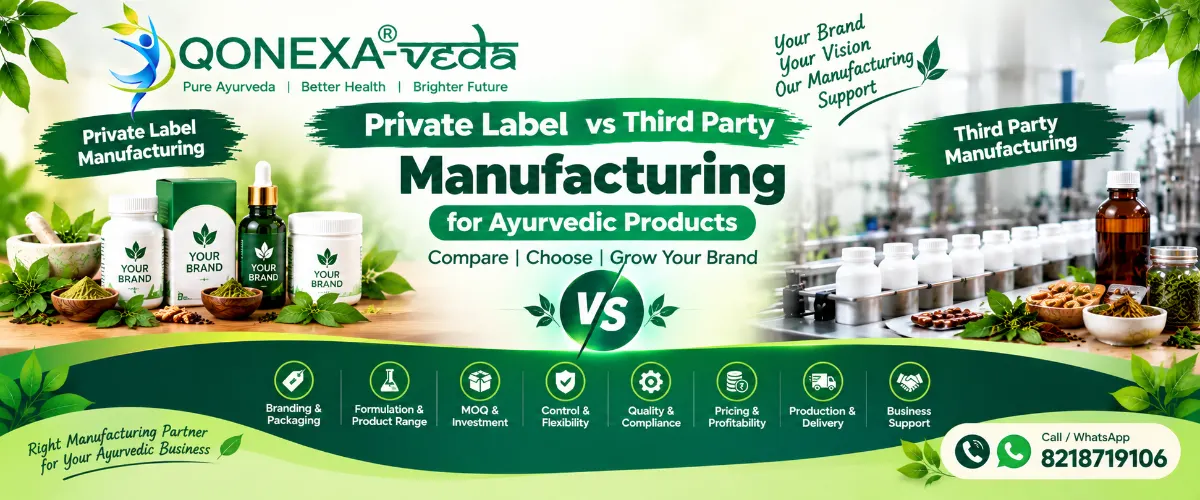
Private Label vs Third Party Manufacturing for Ayurvedic Products
If you are planning to enter the Ayurvedic products market, two manufacturing models that you may come across are private label manufacturing and third party manufacturing. Both models allow a business to work with an experienced manufacturer instead of setting up its own manufacturing facility.
However, the two models can differ in areas such as branding, formulation, packaging, product selection, customization, MOQ, investment and operational control. Understanding these differences can help you select a model that fits your business goals.
- Introduction
- What Is Private Label Ayurvedic Manufacturing?
- What Is Ayurvedic Third Party Manufacturing?
- Private Label vs Third Party Manufacturing
- Branding and Packaging
- Formulation and Product Selection
- MOQ Considerations
- Investment Considerations
- Business Control and Flexibility
- Benefits of Private Label Manufacturing
- Benefits of Third Party Manufacturing
- Which Model Should You Choose?
- Questions to Ask a Manufacturer
- Common Mistakes
- Decision Checklist
- Qonexa Veda
- FAQs
Private Label vs Third Party Manufacturing: Introduction
The Ayurvedic industry includes opportunities for entrepreneurs, distributors, PCD franchise owners and businesses that want to build their own product portfolio. Manufacturing is one of the most important parts of this process.
A business does not always need to establish its own factory. Instead, it can work with an established Ayurvedic Manufacturing Company for production.
Private label and third party manufacturing are two approaches that can help businesses bring Ayurvedic products to market. The right choice depends on your brand strategy, product requirements, budget, expected order volume and level of customization.
Private label generally focuses on selling products under your own brand, while third party manufacturing focuses on having products manufactured by another company according to agreed product and commercial requirements. The exact services offered can vary by manufacturer.
What Is Private Label Ayurvedic Manufacturing?
Private label Ayurvedic manufacturing is a business model where products are manufactured for a company that markets them under its own brand identity, subject to applicable requirements.
The business can work with the manufacturer on areas such as product selection, packaging, labels, artwork and other branding requirements.
Private Label May Include
- Brand name development
- Custom labels
- Product packaging
- Brand-specific artwork
- Selected product formulations
- Customized product presentation
The level of customization depends on the manufacturer and the specific project.
What Is Ayurvedic Third Party Manufacturing?
Ayurvedic third party manufacturing is an arrangement where a business outsources product manufacturing to another manufacturing company.
The manufacturing company handles the agreed production activities while the business focuses on areas such as sales, distribution, marketing and customer development.
Third party manufacturing can be useful for businesses that want to develop or expand an Ayurvedic product range without establishing their own manufacturing facility.
Learn more through our related guide: Ayurvedic Third Party Manufacturing Process: Step-by-Step Guide .
Private Label vs Third Party Manufacturing: Key Differences
| Factor | Private Label | Third Party Manufacturing |
|---|---|---|
| Branding | Usually focused on the buyer's own brand. | Branding depends on the agreed manufacturing arrangement. |
| Packaging | Often includes customized brand packaging. | Can use standard or customized packaging depending on requirements. |
| Product Selection | Can involve selecting products suitable for your brand. | Products are selected according to manufacturing and business requirements. |
| Customization | May provide greater branding customization. | Customization depends on manufacturer capabilities and project scope. |
| MOQ | Can be affected by customized packaging and production requirements. | Depends on product, batch, packaging and manufacturer policy. |
| Business Model | Useful for businesses building their own product brand. | Useful for businesses outsourcing product production. |
| Control | Greater focus on brand presentation. | Greater focus on outsourced production management. |
Branding and Packaging: Which Model Offers More Flexibility?
Branding is one of the biggest considerations when comparing private label with third party manufacturing.
If your primary objective is to build a recognizable Ayurvedic brand, private label manufacturing may be attractive because packaging and brand identity are central to the business model.
Third party manufacturing can also support branded products, depending on the manufacturer's available services and your agreed specifications.
Discuss These Packaging Details
- Product label
- Outer box
- Bottle or container
- Pack size
- Artwork
- Printing
- Batch and product information
- Applicable labeling requirements
Formulation and Product Selection
Product selection is another important area. A business may choose products from an existing catalogue or discuss customization where the manufacturer offers that service.
Before selecting a product, consider market demand, target customers, product positioning, packaging, price point and distribution strategy.
Tablets
A commonly considered format for Ayurvedic and herbal product ranges.
Capsules
Useful for businesses planning capsule-based product portfolios.
Syrups
Liquid products require suitable filling and packaging arrangements.
Oils
Oil products may require specific containers, filling and packaging.
Read our detailed guide: Ayurvedic Product Manufacturing: Tablets, Capsules, Syrups and Oils .
MOQ Considerations
MOQ means Minimum Order Quantity. It represents the minimum quantity a manufacturer may require for a particular product or production order.
MOQ can vary according to product format, batch requirements, packaging, printing, artwork and manufacturer policy.
Customized private label packaging can sometimes create additional packaging quantity requirements, so always ask for both product and packaging MOQ where applicable.
For a detailed explanation, read: MOQ in Ayurvedic Third Party Manufacturing .
Investment Considerations
Neither private label nor third party manufacturing has one universal investment amount. The total cost depends on product specifications, quantity, packaging, formulation, branding, logistics and other commercial conditions.
Consider These Costs
- Product manufacturing
- Packaging
- Label and artwork
- Printing
- Transportation
- Applicable taxes
- Marketing
- Storage
- Working capital
Compare the complete quotation rather than comparing only the per-unit product price. Make sure the product specifications and quantities are the same when comparing manufacturers.
Business Control and Flexibility
Your desired level of control can influence the manufacturing model you choose.
Private label is particularly relevant when your strategy revolves around building your own brand identity and controlling the presentation of your product portfolio.
Third party manufacturing may be suitable when your primary requirement is to outsource production while focusing more heavily on distribution and business development.
In either case, clarify the manufacturer's capabilities and your responsibilities before beginning production.
Benefits of Private Label Ayurvedic Manufacturing
Own Brand Identity
You can build a product portfolio around your own brand identity.
Customized Presentation
Brand-specific packaging can help create a consistent product appearance.
Brand Building
Private label can support a long-term strategy focused on developing your own Ayurvedic brand.
Product Portfolio
Businesses can plan multiple products under a common brand strategy.
Benefits of Ayurvedic Third Party Manufacturing
Outsourced Production
The business can outsource manufacturing instead of establishing its own facility.
Operational Convenience
Manufacturing activities are handled according to the agreed production arrangement.
Product Expansion
Businesses can explore expanding their product range through an external manufacturing partner.
Business Focus
Entrepreneurs can focus more attention on sales, distribution, marketing and customer relationships.
Which Model Should You Choose?
The right choice depends on your business objective. There is no single manufacturing model that is best for every business.
| If Your Main Goal Is... | Consider Discussing... |
|---|---|
| Building your own brand | Private label manufacturing |
| Outsourcing production | Third party manufacturing |
| Customized packaging | Private label options |
| Existing product range | Third party manufacturing options |
| Launching multiple branded products | Private label manufacturing |
| Expanding production capacity | Third party manufacturing |
The final decision should be based on your product requirements, budget, market strategy, expected quantity and the capabilities of the manufacturer you are considering.
Private Label vs Third Party Manufacturing: 7 Questions to Ask
- Which products are available for my business model?
- What is the minimum order quantity?
- What packaging options are available?
- Can I use my own brand name and artwork?
- What manufacturing and quality documentation is available?
- What is the expected production timeline?
- What are the payment, delivery and repeat-order terms?
Questions to Ask Before Choosing a Manufacturer
- What Ayurvedic products do you manufacture?
- Do you provide private label manufacturing?
- Do you provide third party manufacturing?
- What are the applicable MOQs?
- What packaging options are available?
- Can you support customized artwork?
- What quality systems and documentation are available?
- What are the production timelines?
- How is delivery managed?
- How are repeat orders handled?
- What are the payment terms?
Common Mistakes to Avoid
Choosing Only on Price
A low quotation should not be the only factor in manufacturer selection.
Ignoring MOQ
An unsuitable MOQ can affect your inventory and working capital.
Not Checking Packaging
Packaging requirements should be discussed before production begins.
Ignoring Documentation
Relevant manufacturing and product documentation should be reviewed.
Not Comparing Total Cost
Product price, packaging, logistics and other charges should be considered together.
Skipping Written Terms
Important commercial conditions should be clearly understood before placing the order.
Private Label vs Third Party Manufacturing Decision Checklist
- Business objective defined
- Target market identified
- Product range selected
- Branding requirements defined
- Packaging requirements discussed
- MOQ confirmed
- Product pricing received
- Complete quotation compared
- Manufacturing credentials reviewed
- Quality process discussed
- Production timeline confirmed
- Delivery terms understood
- Payment terms understood
- Repeat-order process discussed
Qonexa Veda for Ayurvedic Manufacturing Requirements
Qonexa Veda provides Ayurvedic and herbal manufacturing solutions for businesses exploring private label and third party manufacturing requirements.
If you are planning an Ayurvedic product brand or looking for an external manufacturing partner, discuss your product category, packaging, quantity, branding requirements and business model before finalizing an order.
You can explore additional information through Qonexa.in .
You can also explore: What Is Private Label Ayurvedic Manufacturing and How Does It Work? .
For third party manufacturing: Ayurvedic Third Party Manufacturing Process .
Need Ayurvedic Manufacturing Support?
Discuss private label or third party Ayurvedic manufacturing requirements with Qonexa Veda.
📞 Call: 8218719106 💬 WhatsApp UsFinal Thoughts
The choice between Private Label vs Third Party Manufacturing depends on your business objectives, branding strategy, product requirements, investment capacity and desired level of customization.
Private label manufacturing can be a suitable option for businesses focused on building their own Ayurvedic product brand, while third party manufacturing can be useful for businesses primarily looking to outsource production.
Before making a decision, compare product range, quality systems, MOQ, packaging, pricing, documentation, production timelines and business support. A clear comparison can help you choose a manufacturing arrangement that matches your long-term business plan.
Frequently Asked Questions
What is the difference between private label and third party manufacturing?
Private label manufacturing generally focuses on producing products for sale under the buyer's own brand, while third party manufacturing involves outsourcing product production to another manufacturing company according to agreed requirements.
Is private label better than third party manufacturing?
Neither model is universally better. The right choice depends on your branding strategy, product requirements, budget, MOQ, packaging needs and business objectives.
Can third party Ayurvedic products have my brand name?
This depends on the manufacturing arrangement and applicable requirements. Discuss branding, packaging and labeling with the manufacturer before finalizing the order.
What is MOQ in Ayurvedic manufacturing?
MOQ means Minimum Order Quantity. It is the minimum quantity a manufacturer may require for a particular product or production order.
Does private label manufacturing require customized packaging?
Private label projects commonly involve brand-specific packaging, but the exact packaging options depend on the manufacturer and project requirements.
Which model is suitable for building an Ayurvedic brand?
Private label manufacturing can be considered when the main objective is to build a product portfolio under your own brand identity.
Can I start with a small Ayurvedic product range?
The feasible product quantity depends on the manufacturer's MOQ, product type, packaging and commercial terms. Discuss your expected quantity before finalizing the product range.
What should I compare when choosing an Ayurvedic manufacturer?
Compare product range, manufacturing credentials, quality systems, documentation, MOQ, packaging, pricing, production timeline, delivery and business support.
Can a manufacturer provide both private label and third party manufacturing?
Some manufacturers offer multiple manufacturing models. Confirm the specific services and commercial terms available for your products.
How can I contact Qonexa Veda?
You can contact Qonexa Veda at 8218719106 for Ayurvedic private label and third party manufacturing requirements.
This article is for general informational purposes only. Manufacturing, licensing, labeling, product, taxation and other regulatory requirements can vary according to the product, business activity, location and applicable rules. Verify current requirements with relevant authorities and qualified professionals before making business or regulatory decisions.