
Private Label Ayurvedic Products Manufacturer
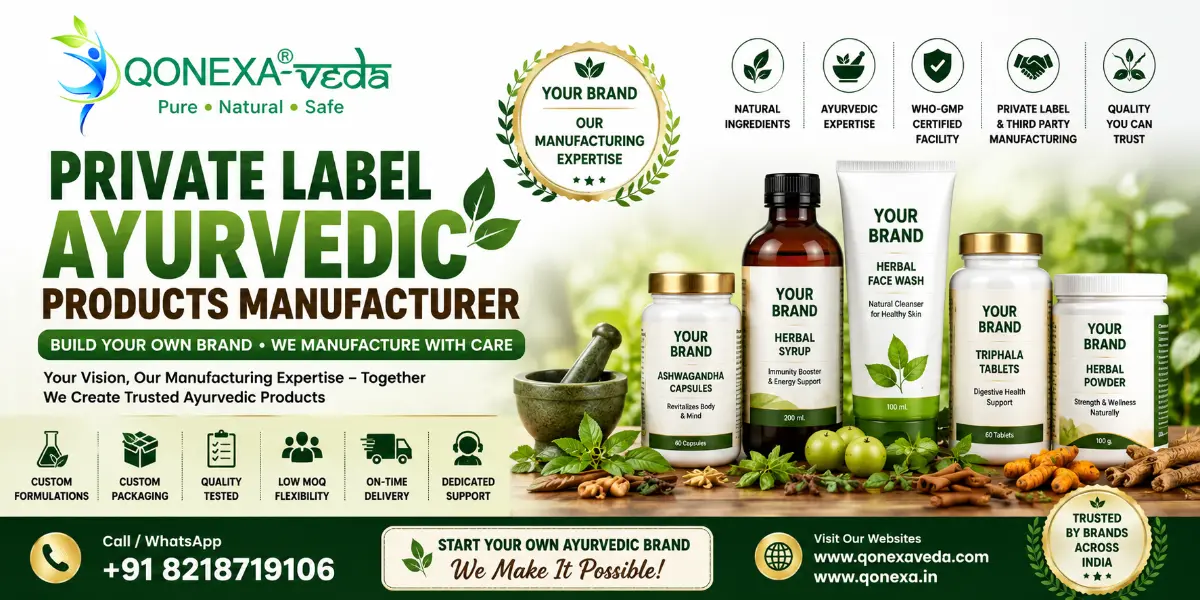
Private Label Ayurvedic Products Manufacturer – Complete Guide for Building Your Own Brand in India
Private label manufacturing gives entrepreneurs, distributors, wellness businesses and emerging healthcare brands a practical way to launch Ayurvedic products under their own brand identity. From product selection and formulation to packaging, labeling and production support, the right manufacturing partner can simplify the journey from an idea to a market-ready product range.
QONEXA Veda supports businesses with Ayurvedic product development, private label manufacturing, packaging and brand-oriented manufacturing solutions. For enquiries, call or WhatsApp +91 8218719106.
What Is Private Label Ayurvedic Manufacturing?
Private label Ayurvedic manufacturing is a business model in which a manufacturer produces Ayurvedic or herbal products for another company, while the products are marketed under the buyer's own brand name. Instead of investing in a complete manufacturing facility, a business can work with an experienced manufacturing partner and concentrate on brand building, distribution, customer relationships and sales.
The process can cover much more than filling a bottle. Depending on the agreement, a manufacturing partner may assist with product selection, formulation options, dosage forms, packaging components, label coordination, batch production and dispatch. The exact scope should always be confirmed before an order is placed.
For a new entrepreneur, this model can reduce operational complexity. For an established distributor, it can help create a differentiated product portfolio. For a wellness brand, it can provide an opportunity to develop products that fit an existing customer base and brand positioning.
Why Private Label Is Becoming Popular for Ayurvedic Brands
India has a long tradition of Ayurveda and herbal wellness, while modern consumers increasingly look for products that fit preventive wellness, personal care and lifestyle routines. This creates opportunities for businesses that can build trustworthy brands with clear positioning and responsible communication.
Private label manufacturing is attractive because the entrepreneur does not necessarily need to build a production unit from the beginning. The business can allocate more attention to market research, packaging presentation, sales channels, distributor development and customer service.
Another advantage is portfolio flexibility. A brand can begin with a focused group of products and expand later based on customer response. This is often more practical than launching a very large range before understanding demand.
How to Choose a Private Label Ayurvedic Products Manufacturer
Choosing a Private Label Ayurvedic Products Manufacturer is one of the most important decisions in a private label project. Price alone should not be the deciding factor. The manufacturer should be evaluated on product suitability, manufacturing capabilities, quality systems, documentation, communication, packaging options, minimum order quantities and delivery expectations.
Before finalizing a partner, ask for clear information about the proposed products, available dosage forms, ingredients or formulation options, packaging choices, production timelines and the documents applicable to the products. A professional discussion at the beginning can prevent misunderstandings later.
1. Check Manufacturing Capability
First understand what the facility can actually manufacture. Tablets, capsules, syrups, powders, oils, creams, gels and other formats may require different equipment and processes. Your partner should have capabilities suitable for the product categories you intend to sell.
2. Review Quality Practices
Ask about quality control, batch testing, raw-material checks, documentation and manufacturing procedures. Where certifications or licenses are applicable, verify the relevant details rather than relying only on promotional claims.
3. Evaluate Product Development Support
If you are starting a new brand, you may need help selecting suitable products and formats. A useful manufacturer should be able to discuss available formulations and practical manufacturing options without making unsupported health claims.
4. Compare Packaging Options
Packaging affects both product protection and brand perception. Discuss bottle types, jars, cartons, labels, seals, outer boxes and other components before approving the final design.
5. Understand Minimum Order Quantities
Minimum order quantity, or MOQ, can have a major effect on your initial investment. A new business should avoid ordering quantities that are far beyond realistic demand simply to obtain a lower unit cost.
Private Label Ayurvedic Products: From Idea to Finished Product
A successful private label project normally moves through several stages. Planning these stages in advance makes the project easier to manage and gives both the brand owner and manufacturer a shared understanding of the final product.
Stage 1: Define Your Brand Positioning
Start with the customer and market rather than the bottle. Decide whether your brand will focus on general wellness, personal care, nutrition-oriented products, traditional Ayurvedic positioning or another clearly defined category. A focused identity makes product selection and marketing easier.
Stage 2: Select the Product Category
Choose a manageable initial range. Consider the customer's needs, your distribution network, price segment, competition and expected repeat purchase. A smaller portfolio with a clear purpose can be easier to launch than a large catalogue.
Stage 3: Discuss Formulation and Specifications
Share your product concept with the manufacturer. Discuss dosage form, pack size, ingredient specifications, serving or usage directions where applicable, and other product requirements. Any regulatory or labeling requirements should be reviewed for the specific product and market.
Stage 4: Approve Samples
Samples are important because the final product should be evaluated before a commercial production run. Depending on the category, the brand owner may review appearance, taste, texture, fragrance, packaging fit and other relevant characteristics.
Stage 5: Finalize Packaging
Once the product specification is agreed, finalize the packaging components and artwork. Check brand name, product name, net quantity, directions, warnings, batch information and other applicable label requirements carefully before printing.
Stage 6: Production and Quality Checks
The approved specifications are used for the manufacturing batch. Appropriate quality checks and documentation should be maintained according to the product and manufacturing system.
Stage 7: Dispatch and Brand Launch
After production and release, products can be dispatched according to the agreed plan. The brand can then focus on distribution, online visibility, retailer or distributor relationships and customer support.
Product Categories You Can Explore Under a Private Label Brand
The exact product range depends on manufacturing capability, applicable regulations and market strategy. Businesses may explore different Ayurvedic and herbal product formats such as:
- Ayurvedic tablets and capsules
- Herbal powders
- Ayurvedic syrups and liquid products
- Herbal oils
- Ayurvedic personal care products
- Creams, gels and topical formats where applicable
- Traditional wellness-oriented formulations
- Herbal combinations designed for specific permitted product categories
Product claims should be appropriate to the product category and applicable rules. A strong brand should communicate responsibly instead of promising guaranteed cures or unrealistic results.
Packaging and Labeling for Private Label Ayurvedic Products
Packaging is one of the first things customers notice. A professional pack should combine visual appeal with useful information and appropriate product protection. Your brand identity should remain consistent across bottles, cartons, labels and digital marketing material.
When preparing artwork, carefully review the spelling of the brand and product name, net quantity, directions, storage information, batch details, manufacturer information and other particulars that may be required for the specific product. It is better to complete a structured artwork approval process than to discover an error after printing.
Packaging materials should also be selected according to the product. A liquid, oil, powder and cream can have different packaging needs. Your manufacturing partner can help identify practical options based on the product format and desired presentation.
How Much Does Private Label Ayurvedic Manufacturing Cost?
There is no single price for private label manufacturing because the final cost depends on several variables. Product formulation, ingredients, dosage form, pack size, packaging material, artwork, quantity, testing and logistics can all affect the total.
| Cost Factor | Why It Matters |
|---|---|
| Product formulation | Different formulations can require different ingredients, processes and specifications. |
| Raw materials | Ingredient quality, availability and specification influence the manufacturing cost. |
| Dosage form | Tablets, capsules, liquids, oils, powders and topical products may have different production requirements. |
| Packaging | Bottles, jars, cartons, labels, seals and other components contribute to the finished cost. |
| Order quantity | Larger batches may change per-unit economics, but the right quantity should match realistic demand. |
| Testing and documentation | Applicable testing and documentation requirements can add to project costs. |
| Logistics | Shipping distance, packaging protection and dispatch method influence the delivered cost. |
Instead of asking only for the lowest unit price, compare the complete commercial proposal. A slightly higher quote may be more practical if it includes better packaging, clearer documentation, dependable communication and consistent production support.
MOQ: What New Brands Should Know
MOQ is the minimum quantity a manufacturer is prepared to produce for a particular product or packaging setup. It may differ between products and can also depend on the type of packaging, raw materials and customization involved.
New businesses should balance three things: the cost advantage of a larger order, the cash tied up in inventory and the realistic speed of sales. An unnecessarily large opening order can create storage and working-capital pressure.
A useful approach is to identify a small launch portfolio, estimate realistic monthly sales, calculate the expected stock period and then discuss suitable quantities with the manufacturer.
Private Label vs Third-Party Manufacturing
The terms private label and third-party manufacturing are sometimes used together, but they can describe different business arrangements. In private label, the emphasis is often on selling a product under the buyer's brand, with manufacturing handled by a partner. Third-party manufacturing is a broader outsourcing model in which a company contracts another manufacturer to produce products according to agreed specifications.
| Point | Private Label | Third-Party Manufacturing |
|---|---|---|
| Brand ownership | Usually the buyer markets under its own brand. | Can also be under the buyer's brand depending on the agreement. |
| Customization | Can range from selected ready formulations to customized specifications. | Depends on the manufacturing contract and technical requirements. |
| Packaging | Often designed around the buyer's brand identity. | Can be customized according to the agreed scope. |
| Best suited for | Entrepreneurs and brands wanting their own market identity. | Businesses looking to outsource production capacity. |
Benefits of Working With a Professional Private Label Partner
A capable manufacturing partner can provide several practical benefits. The first is reduced infrastructure burden. Instead of building a production facility, the business can work with an established manufacturing setup and invest more heavily in branding and distribution.
The second benefit is speed of execution. A manufacturer with established processes, product categories and packaging relationships can help a business move from product concept to production in a more organized manner.
The third benefit is scalability. Once a product gains traction, the business can discuss repeat batches, additional pack sizes or new products with the same manufacturing partner.
Finally, a long-term partner can help the business maintain consistency. Consistent product specifications, packaging and documentation are important for a professional brand.
Common Mistakes to Avoid
- Choosing only on price: The cheapest quote is not automatically the best manufacturing solution.
- Launching too many products: A large portfolio can spread marketing and inventory budgets too thin.
- Skipping sample approval: Commercial production should not be approved blindly.
- Ignoring packaging details: Artwork errors can create avoidable delays and costs.
- Making unsupported claims: Marketing should follow applicable product and advertising requirements.
- Not clarifying MOQ: Always understand minimum quantities before finalizing the commercial plan.
- Ignoring delivery planning: Production time, packaging time and shipping time should be considered together.
- Having no launch strategy: Manufacturing a product does not automatically create demand.
How to Build a Strong Private Label Ayurvedic Brand
Manufacturing is only one part of the business. A strong brand also needs a clear audience, recognizable visual identity, useful content and a distribution strategy.
Build a Clear Brand Identity
Your name, logo, packaging language, website and social media should communicate one consistent identity. Avoid changing the visual style from one product to another without a reason.
Understand Your Customer
Identify who the product is designed for, what problem or routine it addresses within the permitted claims, where those customers shop and what influences their purchase decisions.
Use Educational Content
Blogs, videos, product explainers and FAQs can help customers understand ingredients, product usage and brand philosophy. Educational content should be accurate and responsible.
Develop Distribution
Depending on your model, you can evaluate distributors, retailers, professional networks, marketplaces and your own website. The right mix depends on your product and target customer.
Questions to Ask Before Placing Your First Order
- What product categories can you manufacture?
- What are the available dosage forms and pack sizes?
- What is the MOQ for each selected product?
- Can I use my own brand name and packaging?
- What packaging options are available?
- What is the expected production timeline?
- What quality checks and documentation are applicable?
- How are samples approved before commercial production?
- What information is required for artwork approval?
- What are the payment and dispatch terms?
- How are repeat orders handled?
Why QONEXA Veda Can Be Considered for Private Label Projects
QONEXA Veda is positioned to support businesses looking to develop and market Ayurvedic and herbal product ranges under their own brand. The focus is on practical manufacturing support, product selection, packaging coordination and a business-oriented approach to launching a product range.
For a new entrepreneur, the objective should be to build a realistic product plan rather than simply collect a long catalogue. QONEXA Veda can discuss the business requirement, product category, packaging direction and manufacturing requirements so the project can be planned according to the intended market.
Businesses should still evaluate the exact product specifications, applicable documentation, commercial terms and manufacturing requirements before placing an order. Clear communication between the brand owner and manufacturer is the foundation of a successful long-term relationship.
Ready to Start Your Own Ayurvedic Brand?
Discuss your private label product requirement with QONEXA Veda.
Call +91 8218719106 WhatsApp UsVisit: QONEXA Veda
Frequently Asked Questions
What is a private label Ayurvedic product?
A private label Ayurvedic product is manufactured by a third-party manufacturing partner and marketed by a business under its own brand name, subject to the applicable product category, agreements and regulatory requirements.
Can I launch my own Ayurvedic brand without owning a manufacturing unit?
Yes, businesses can explore contract or private label manufacturing arrangements instead of building their own production facility. The exact arrangement, documentation and responsibilities should be agreed with the manufacturer.
What products can be developed through private label manufacturing?
Depending on the manufacturer's capabilities and applicable requirements, businesses may explore tablets, capsules, powders, syrups, oils, personal care formats and other Ayurvedic or herbal products.
How do I choose the right private label manufacturer?
Compare manufacturing capability, quality practices, product range, packaging options, MOQ, documentation, communication, production timelines and commercial terms instead of selecting only on price.
Is sample approval necessary before bulk production?
Sample approval is a useful step because it allows the brand owner to review the proposed product and packaging before commercial production. The approval process should be documented clearly.
What affects private label Ayurvedic product cost?
Formulation, raw materials, dosage form, packaging, order quantity, testing, documentation and logistics can all influence the final cost.
Can I customize the packaging for my own brand?
Private label projects commonly involve brand-specific packaging, subject to the manufacturer's available options and applicable labeling requirements. Artwork should be reviewed carefully before printing.
How can I contact QONEXA Veda for a private label requirement?
You can contact QONEXA Veda by calling or WhatsApping +91 8218719106 to discuss your product, packaging and manufacturing requirement.
Planning Your Portfolio With a Private Label Ayurvedic Products Manufacturer
A private label launch becomes easier when the product portfolio is planned before manufacturing begins. Instead of selecting products only because they are available, consider how every product will fit into the same brand story. A coherent portfolio can make packaging, website navigation, distributor presentations and customer communication much easier.
Start by identifying one or two customer segments and then map the product categories that are relevant to them. Consider whether customers are likely to purchase a product once, seasonally or repeatedly. Also consider the expected selling price, packaging size, storage requirements and the channels through which the product will be sold.
It is useful to maintain a simple product-development sheet containing the product name, category, dosage form, pack size, target customer, proposed price segment, packaging preference, MOQ, expected lead time and status of sample approval. This creates a common reference for the brand owner and manufacturing partner.
What a Professional Manufacturing Brief Should Contain
Before requesting a commercial quotation, prepare a clear manufacturing brief. The brief does not need to be complicated, but it should provide enough information for the manufacturer to understand what you are trying to build.
- Brand name and business details
- Proposed product categories
- Preferred dosage forms
- Target pack sizes
- Expected initial quantity
- Packaging preferences
- Target market and distribution model
- Expected price segment
- Any specific formulation or ingredient preferences
- Expected launch timeline
A good brief can improve the quality of the quotation because the manufacturer is comparing the same requirements you have in mind. It also reduces repeated conversations and helps identify missing information early.
How Packaging Supports Brand Positioning
Private label products compete not only on the product itself but also on how clearly the brand communicates its identity. A clean and consistent packaging system can help customers recognize products from the same company. The design should be appropriate to the product category and should not create misleading impressions about benefits or performance.
Think about a packaging family rather than designing every product independently. Similar typography, logo placement, information hierarchy and visual elements can create a recognizable shelf presence. At the same time, each product should be easy to distinguish by name, category and pack size.
Before final artwork approval, review every visible element carefully. Check spelling, net quantity, contact details, directions, storage information, batch-related fields and other applicable declarations. Ask the manufacturing partner to confirm technical information that must appear on the label for the particular product.
Quality and Consistency in Repeat Manufacturing
Launching the first batch is only the beginning. Customers expect repeat purchases to deliver a consistent experience. For that reason, the brand owner should understand how product specifications are maintained between batches and how changes are communicated.
Keep approved product specifications, packaging artwork and sample references organized. If a change in raw material, packaging component or process becomes necessary, discuss the change before the next commercial batch wherever appropriate. A documented approval process can help prevent avoidable surprises.
Consistency also matters in packaging. A bottle, label or carton may look slightly different when suppliers change, so the brand should communicate its acceptable specifications clearly. The manufacturing partner can then work within the agreed requirements.
Building Trust Through Responsible Ayurvedic Marketing
A strong Ayurvedic brand should build trust through clarity rather than exaggerated promises. Product pages, advertisements, social media posts and sales material should use claims appropriate to the product category and applicable requirements. Avoid language that guarantees cures, promises universal results or creates unrealistic expectations.
Educational content can focus on product information, traditional context where appropriate, ingredients, directions for use, storage, packaging and general wellness information. When customers receive clear information, they are more likely to understand what the product is and how it fits into their routine.
Trust is also built through responsive customer service. Keep contact details visible, answer product questions carefully and provide consistent information across your website, packaging and sales channels.
Digital Presence for a Private Label Brand
A new product range needs a digital home. A professional website can present the brand story, product catalogue, contact options, frequently asked questions and useful educational content. Search-friendly articles can help potential customers discover the brand when they are researching Ayurvedic and herbal products.
Social media can support awareness, but it should work together with the website rather than replace it. Product photography, short educational videos, customer-service information and behind-the-scenes brand content can be used to build familiarity.
Search engine optimization should be handled naturally. Use one primary topic for each article, create useful headings, write descriptive page titles and descriptions, connect related pages with internal links and avoid stuffing the same phrase repeatedly.
Launch Checklist for Your First Private Label Batch
| Area | Checklist |
|---|---|
| Brand | Brand name, logo, positioning and customer segment are finalized. |
| Product | Product category, format, specifications and sample are approved. |
| Packaging | Pack size, container, label and outer packaging are finalized. |
| Compliance | Applicable label information and product documentation are reviewed. |
| Commercials | MOQ, quotation, payment terms and dispatch expectations are documented. |
| Inventory | Storage space and expected sales requirements are considered. |
| Marketing | Website, product pages, basic content and sales material are prepared. |
| Customer Support | Phone/WhatsApp and product enquiry handling are ready before launch. |
How to Build a Long-Term Manufacturer Relationship
The best manufacturing relationships are based on clear expectations and regular communication. Share forecasts when possible, provide feedback on samples, approve artwork on time and keep commercial records organized. Manufacturers also benefit when brand owners provide complete information and avoid last-minute specification changes.
As sales grow, discuss repeat-order planning rather than waiting until inventory becomes critically low. Advance planning can make it easier to coordinate raw materials, packaging and production schedules.
It is also useful to review the relationship periodically. Look at product consistency, delivery performance, communication quality, packaging accuracy and issue resolution. If the partnership is working well, expanding the portfolio can become much easier than starting a new manufacturing relationship for every product.
Who Can Benefit From Private Label Ayurvedic Manufacturing?
The model can be relevant to many types of businesses. A distributor may want to move from selling multiple brands to building an owned portfolio. A wellness entrepreneur may want to create a focused product line. A retail business may want products aligned with its existing customer base. An online business may want to introduce a branded range that it can market through its own channels.
The common requirement is a clear business plan. Manufacturing can provide the product, but the brand owner still needs to understand customers, pricing, distribution, marketing and inventory management. A realistic plan is more important than simply having a large product catalogue.
Final Decision: What Should You Compare?
Before selecting a manufacturing partner, create a simple comparison sheet. Record each manufacturer's product capabilities, MOQ, packaging choices, sample process, estimated lead time, documentation, communication and quotation. This makes the decision less dependent on a single conversation or price.
Most importantly, choose a partner whose manufacturing capability matches the products you actually want to sell. A manufacturer that understands your category and can communicate clearly may be more valuable over the long term than a supplier selected only because its initial quotation is the lowest.
Final Thoughts for Businesses Choosing a Private Label Ayurvedic Products Manufacturer
Working with a Private Label Ayurvedic Products Manufacturer can be a practical route for entrepreneurs and established businesses that want to build an Ayurvedic product brand without taking on the full infrastructure of an in-house manufacturing facility. The strongest projects begin with clear positioning, sensible product selection, careful sample approval, appropriate packaging and a realistic sales plan.
The manufacturer you choose should be treated as a long-term business partner rather than simply a supplier. Evaluate capabilities, quality systems, documentation, communication and delivery performance alongside pricing. With the right planning, a focused product portfolio and consistent brand building, private label manufacturing can provide a structured foundation for entering the Ayurvedic and herbal products market.
Explore more healthcare and business resources: QONEXA Lifecare