How to Choose a GMP Certified Ayurvedic Manufacturer in India
Choosing the right manufacturing partner is one of the most important decisions for an Ayurvedic product business. Whether you are planning a PCD pharma franchise, private label brand or third-party manufacturing project, the manufacturer you select can influence product consistency, documentation, packaging, supply planning and your overall business operations.
A GMP Certified Ayurvedic Manufacturer can be an important consideration when evaluating manufacturing facilities and suppliers. However, certification should not be the only factor you check. Product requirements, manufacturing capabilities, documentation, quality systems, commercial terms and business support should also be evaluated.
- Introduction
- What Does GMP Mean?
- Why GMP Matters in Ayurvedic Manufacturing
- What to Check Before Choosing a Manufacturer
- Verify Manufacturing Credentials
- Evaluate Manufacturing Facilities
- Check the Product Range
- Understand Quality Control
- Review Product Documentation
- Check Packaging and Labeling
- Understand MOQ and Pricing
- Evaluate Production Capacity
- Check Business Support
- Questions to Ask a Manufacturer
- Common Mistakes to Avoid
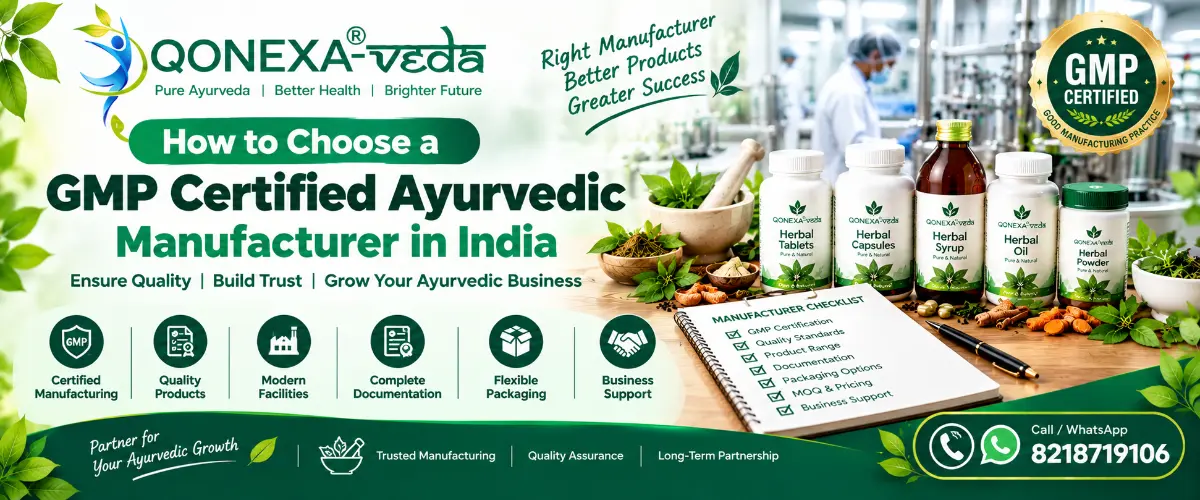
- Manufacturer Selection Checklist
- Why Consider Qonexa Veda?
- Frequently Asked Questions
Introduction
The Ayurvedic and herbal products market includes a wide range of product formats, formulations and business models. Entrepreneurs may want to launch their own brand, distribute existing products or develop a product portfolio for a PCD franchise.
In each case, finding an appropriate manufacturing partner is an important business decision. A manufacturer should be evaluated not only on price but also on manufacturing capability, product suitability, quality processes, documentation, packaging options, delivery planning and communication.
The term GMP Certified Ayurvedic Manufacturer is often used when discussing manufacturing standards. GMP, or Good Manufacturing Practice, generally refers to systems and practices designed to help ensure products are consistently manufactured and controlled according to applicable quality standards.
GMP certification or compliance is only one part of manufacturer evaluation. Always verify the specific certification, scope, validity and applicability for the facility and products you are considering.
What Does GMP Mean in Ayurvedic Manufacturing?
GMP stands for Good Manufacturing Practice. GMP principles focus on controlled manufacturing processes, appropriate facilities, documentation, hygiene, quality systems and other procedures relevant to consistent product manufacturing.
For an Ayurvedic manufacturing business, GMP-related systems may cover areas such as raw material handling, production processes, equipment, personnel, documentation, quality control and storage.
The specific requirements and certifications applicable to an Ayurvedic facility depend on the product category, manufacturing activity and regulatory framework.
Why GMP Matters in Ayurvedic Manufacturing
When you work with a manufacturer, you want a predictable and organized production process. Manufacturing standards can provide a framework for managing different aspects of production and quality.
1. Process Control
Established manufacturing procedures can help maintain consistency across production activities.
2. Documentation
Organized documentation can support traceability and controlled manufacturing operations.
3. Quality Systems
Quality control procedures can help manufacturers monitor applicable product and production parameters.
4. Business Confidence
A transparent manufacturing system can make it easier for business partners to understand how products are produced and managed.
For this reason, GMP should be considered alongside other practical factors when selecting an Ayurvedic manufacturer.
What to Check Before Choosing an Ayurvedic Manufacturer
Before finalizing a manufacturer, create a structured evaluation process. Instead of comparing companies only by price, review several areas.
| Factor | What to Evaluate |
|---|---|
| Manufacturing Credentials | Applicable licenses, certifications and facility credentials. |
| Product Range | Dosage forms, categories and products matching your business plan. |
| Quality | Quality control systems, testing and documentation. |
| Packaging | Available pack sizes, materials, artwork and labeling support. |
| MOQ | Minimum order quantities and their suitability for your budget. |
| Production Capacity | Ability to manage your expected order volumes. |
| Delivery | Dispatch process, lead times and logistics arrangements. |
| Communication | Responsiveness and clarity during the project. |
1. Verify the Manufacturer's Credentials
One of the first steps is to ask the manufacturer about its relevant manufacturing credentials.
Do not rely only on a website statement such as "GMP certified." Request appropriate documentation and verify that the certificate or credential relates to the actual facility and manufacturing activity being discussed.
Things to Verify
- Manufacturer's legal/business identity
- Applicable manufacturing permissions
- Relevant GMP certification or documentation
- Certification validity, where applicable
- Scope of the certification
- Facility information
- Product categories covered by the manufacturing arrangement
Ask for current documentation rather than relying on an old certificate, catalogue or third-party promotional material.
2. Evaluate the Manufacturing Facility
A manufacturer's facility and operational systems can provide useful information about its production capabilities.
If possible, request appropriate information about the manufacturing unit, production areas, equipment, storage arrangements and quality-control facilities.
Areas You Can Review
- Production areas
- Raw material storage
- Finished product storage
- Production equipment
- Packaging areas
- Quality control facilities
- Hygiene and operational procedures
- Documentation systems
A professional manufacturer should be able to explain its manufacturing process and relevant quality procedures clearly.
3. Check the Ayurvedic Product Range
The right manufacturer should have products that match your business requirements. A large catalogue is not automatically better if the products do not fit your target market.
Consider Product Categories Such As
- Tablets
- Capsules
- Syrups
- Oils
- Powders
- Herbal products
- Other applicable Ayurvedic product formats
Consider your intended market, target customers, product positioning, competition, price range and distribution model before finalizing the portfolio.
For product planning, you can also read: How to Select the Right Ayurvedic Products for PCD Franchise .
4. Understand the Quality Control Process
Quality management is an important part of manufacturing evaluation. Ask the manufacturer how raw materials, production processes and finished products are handled and checked.
Questions to Ask
- How are raw materials received and managed?
- What quality checks are performed?
- How are batches identified?
- How are manufacturing records maintained?
- What quality documentation is available?
- How are finished products released?
The exact testing and documentation requirements depend on the product and applicable standards. Your manufacturer should be able to explain the process relevant to your products.
5. Review Product Documentation
Documentation is an important consideration when developing an Ayurvedic product portfolio. Before placing a significant order, understand what documentation will be provided and which documents apply to your products.
Product Information
Understand formulation-related information, pack size, dosage form and applicable product details.
Batch Information
Understand how products are identified and traced through batch information.
Quality Records
Ask about relevant quality documentation associated with the manufacturing process.
Packaging Information
Review label information, pack sizes and other applicable packaging details.
Keep copies of commercially relevant documents and records in an organized business file.
6. Check Packaging and Labeling Support
Packaging is not only about appearance. It also plays a role in product presentation, information and business branding.
If you are developing a private label Ayurvedic brand, discuss packaging options before finalizing your manufacturer.
Discuss These Points
- Bottle, box, pouch or other applicable formats
- Available pack sizes
- Label design requirements
- Printing options
- Artwork specifications
- Product information on labels
- Packaging timelines
- Minimum packaging quantities
All labels and promotional claims should be reviewed against applicable requirements before production.
7. Understand MOQ and Pricing
MOQ means Minimum Order Quantity. Different manufacturers may have different MOQs depending on the product, packaging and manufacturing requirements.
Do not select a manufacturer solely because it offers a low price. A lower quoted price may not necessarily represent the lowest overall business cost.
Compare the Complete Commercial Picture
- Product price
- Minimum order quantity
- Packaging cost
- Artwork or printing cost
- Applicable taxes
- Transportation
- Payment terms
- Lead time
Request a written quotation with clearly defined commercial terms so you can compare manufacturers on the same basis.
8. Evaluate Production Capacity
If your business grows, you may need larger quantities. Therefore, it is useful to understand whether the manufacturer can support your expected production requirements.
Ask about production planning, lead times, available dosage forms and the manufacturer's ability to handle repeat orders.
Useful Questions
- What is the typical production lead time?
- How are repeat orders handled?
- Can the manufacturer support larger future orders?
- How are urgent requirements managed?
- How is dispatch planned?
9. Check Business and Customer Support
Manufacturing is a long-term business relationship in many cases. Clear communication can therefore be important from product selection to delivery.
Evaluate the Manufacturer's Support
- Product selection assistance
- Quotation support
- Packaging guidance
- Artwork coordination
- Order updates
- Dispatch communication
- After-order support
A manufacturer should communicate commercial terms clearly and provide realistic timelines rather than making unclear promises.
10. Questions to Ask a GMP Certified Ayurvedic Manufacturer
Before finalizing your manufacturing partner, prepare a list of questions. This makes it easier to compare multiple companies.
- What manufacturing certifications and permissions are applicable?
- Can you provide current certification documentation?
- Which Ayurvedic product categories do you manufacture?
- What packaging formats are available?
- What are the minimum order quantities?
- What is the expected production timeline?
- What quality checks are performed?
- What product documentation is available?
- What are the payment terms?
- How are repeat orders handled?
- Do you support private label products?
- Do you provide product catalogues and business support?
Common Mistakes to Avoid When Choosing an Ayurvedic Manufacturer
Choosing Only on Price
The lowest quotation should not automatically determine your manufacturing decision.
Not Verifying Credentials
Always request and review appropriate current documentation.
Ignoring MOQ
An unsuitable MOQ can create unnecessary inventory or cash-flow pressure.
Skipping Product Evaluation
Select products based on your business strategy rather than simply choosing the largest available catalogue.
Ignoring Packaging
Packaging requirements should be discussed before placing the order.
Not Reviewing the Agreement
Commercial terms should be clear before entering into a long-term business arrangement.
GMP Certified Ayurvedic Manufacturer Selection Checklist
Use this checklist when comparing potential manufacturing partners:
- Manufacturer identity verified
- Applicable manufacturing credentials reviewed
- GMP documentation checked where applicable
- Product range evaluated
- Quality control process discussed
- Product documentation reviewed
- Packaging options confirmed
- MOQ confirmed
- Pricing compared
- Payment terms understood
- Production lead time confirmed
- Delivery process understood
- Business support evaluated
- Agreement reviewed
- Long-term supply capability discussed
GMP Certified Ayurvedic Manufacturer vs Low-Cost Supplier
When comparing manufacturers, it is useful to look beyond the initial product price. A supplier with appropriate manufacturing systems, documentation and business support may provide a different overall commercial proposition from a supplier selected only for low pricing.
| Evaluation Area | What to Look For |
|---|---|
| Quality Systems | Documented and appropriate quality processes. |
| Manufacturing Credentials | Current and relevant credentials applicable to the facility. |
| Documentation | Clear product and manufacturing documentation. |
| Product Range | Products matching your market and business plan. |
| Packaging | Suitable packaging and branding options. |
| Commercial Terms | Transparent MOQ, pricing and payment conditions. |
Why Consider Qonexa Veda for Ayurvedic Manufacturing?
Qonexa Veda works in the Ayurvedic and herbal product manufacturing space and offers manufacturing-related solutions for businesses exploring Ayurvedic products, PCD franchise opportunities and private label requirements.
If you are looking for an Ayurvedic manufacturing partner, discuss your product category, required dosage form, packaging requirements, expected quantity and business model before finalizing the manufacturing arrangement.
You can explore additional information through Qonexa.in .
You can also explore our related guide: Ayurvedic Third Party Manufacturing Process: Step-by-Step Guide .
For businesses planning their own brand, our Private Label Ayurvedic Manufacturing guide can also help with initial planning.
Looking for Ayurvedic Manufacturing Support?
Discuss your Ayurvedic product, PCD franchise, third-party manufacturing or private label requirements with Qonexa Veda.
📞 Call: 8218719106 💬 WhatsApp UsFinal Thoughts
Choosing a GMP Certified Ayurvedic Manufacturer should be based on more than a certification label or product price. A proper evaluation should include manufacturing credentials, product range, quality systems, documentation, packaging, MOQ, pricing, production capacity and business support.
Before placing an order, request appropriate documentation, clarify commercial terms and understand how the manufacturer will support your requirements. Taking these steps can help you build a more organized and transparent manufacturing relationship.
Whether you are planning an Ayurvedic PCD franchise, third-party manufacturing project or private label brand, selecting the right manufacturing partner is an important part of your business planning.
Frequently Asked Questions
What is a GMP Certified Ayurvedic Manufacturer?
A GMP Certified Ayurvedic Manufacturer is a manufacturer operating under applicable Good Manufacturing Practice standards and holding relevant certification where required. Always verify the current certification and its scope for the facility and products concerned.
Why should I choose a GMP certified Ayurvedic manufacturer?
GMP-related systems can provide a structured framework for manufacturing, quality control, documentation and operational processes. They should be considered alongside other manufacturer-selection factors.
How can I verify an Ayurvedic manufacturer's GMP certification?
Ask the manufacturer for current certification documentation and review the issuer, validity, scope and facility details. If necessary, verify the information with the relevant certification or regulatory body.
What should I check before choosing an Ayurvedic manufacturer?
Review manufacturing credentials, product range, quality systems, documentation, packaging, MOQ, pricing, production capacity, delivery and business support.
Is GMP certification enough to select a manufacturer?
No. GMP-related certification is one consideration. Product suitability, documentation, quality systems, commercial terms, capacity and support should also be evaluated.
What is MOQ in Ayurvedic manufacturing?
MOQ means Minimum Order Quantity. It is the minimum quantity a manufacturer may require for a particular product or production order.
Can an Ayurvedic manufacturer provide private label products?
Some manufacturers offer private label services. Confirm the available products, packaging options, branding process, MOQ and commercial terms with the manufacturer.
What product forms can Ayurvedic manufacturers produce?
Depending on the facility, manufacturers may offer products such as tablets, capsules, syrups, oils, powders and other applicable formats.
How do I compare two Ayurvedic manufacturers?
Compare them using the same criteria, including credentials, quality systems, products, documentation, MOQ, pricing, packaging, production timelines, delivery and support.
How can I contact Qonexa Veda?
You can contact Qonexa Veda at 8218719106 for Ayurvedic manufacturing, PCD franchise and private label requirements.
This article is provided for general informational purposes only. GMP, manufacturing, licensing, product, labeling, taxation and other regulatory requirements can vary according to the product, business activity, location and applicable rules. Verify current requirements with relevant authorities and qualified professionals before making business or regulatory decisions.