Private Label Ayurvedic Manufacturing
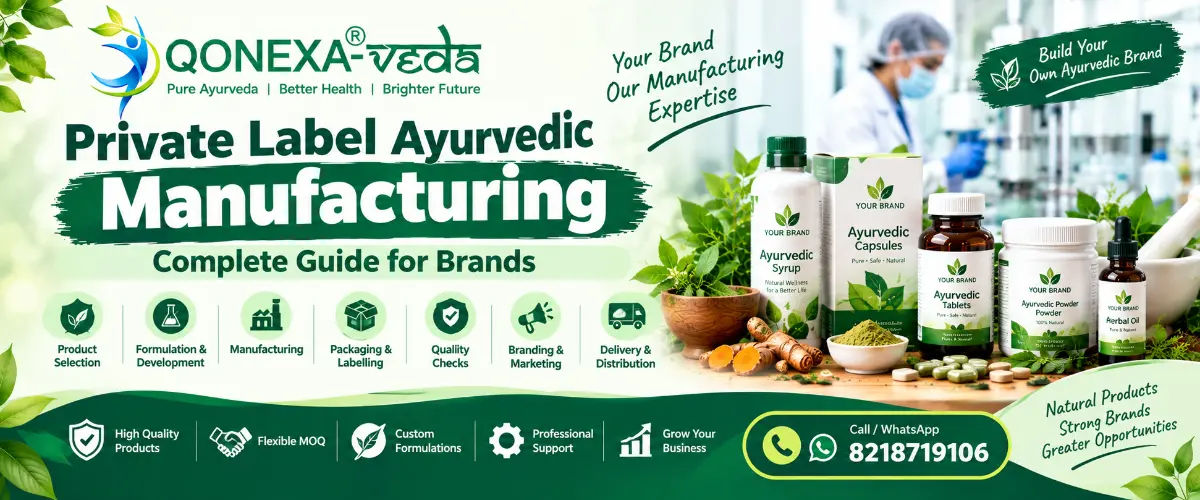
Private Label Ayurvedic Manufacturing: Complete Guide for Brands
Discover how private label Ayurvedic manufacturing can help businesses develop branded Ayurvedic products without setting up their own manufacturing facility. Learn about product selection, formulation, packaging, branding, quality checks, documentation and market launch.
Table of Contents
- What Is Private Label Ayurvedic Manufacturing?
- How Does Private Label Ayurvedic Manufacturing Work?
- Benefits of Private Label Ayurvedic Manufacturing
- Choosing the Right Ayurvedic Products
- How to Choose a Private Label Manufacturer
- Product Formulation and Development
- Packaging and Branding
- Documentation and Compliance
- Quality Control and Manufacturing
- Private Label Ayurvedic Manufacturing Cost Factors
- Common Mistakes to Avoid
- How to Launch Your Ayurvedic Brand
- Why Work With Qonexa Veda?
- Private Label Launch Checklist
- Frequently Asked Questions
What Is Private Label Ayurvedic Manufacturing?
Private label Ayurvedic manufacturing is a business model in which an Ayurvedic manufacturer produces products for another business that sells those products under its own brand name. Instead of investing in a complete manufacturing facility, equipment, production team and related infrastructure, a brand owner can work with an experienced manufacturing partner.
This model can be useful for entrepreneurs, distributors, healthcare businesses, wellness companies, startups and established brands that want to introduce Ayurvedic products into the market. Depending on the arrangement, the manufacturer may support product selection, formulation, manufacturing, packaging, labelling and dispatch.
The major attraction of private labeling is brand ownership. The business can focus on brand identity, distribution, sales and customer relationships while the manufacturing partner handles the production side according to the agreed specifications.
How Does Private Label Ayurvedic Manufacturing Work?
The process generally begins with a business identifying a product opportunity. The brand owner then discusses product requirements with a manufacturer and finalizes the product category, specifications, packaging requirements and commercial terms.
1. Product Planning
Identify the type of Ayurvedic product, target market, dosage form, positioning and expected customer requirements.
2. Product Selection
Choose products from the manufacturer's available range or discuss suitable customization requirements.
3. Branding
Develop your brand identity, product name, packaging design, label artwork and marketing presentation.
4. Manufacturing
The approved product is manufactured according to agreed specifications and applicable quality procedures.
5. Quality Checks
Products undergo appropriate quality checks before being prepared for dispatch.
6. Dispatch
Finished products are packed and dispatched according to the finalized order and delivery requirements.
A good private-label project should therefore be planned as a complete business process rather than simply ordering products with a logo. Product positioning, brand identity, packaging, target market, pricing and distribution all influence the final outcome.
Benefits of Private Label Ayurvedic Manufacturing
There are several reasons businesses explore private label Ayurvedic manufacturing. The model allows entrepreneurs to enter the Ayurvedic product market while concentrating resources on branding and market development.
1. Build Your Own Brand
One of the biggest advantages is the ability to create a distinct brand identity. Your products can carry your chosen brand name, packaging concept and visual identity, subject to applicable requirements.
2. Avoid Setting Up a Manufacturing Facility
Establishing a manufacturing facility requires infrastructure, equipment, technical resources, quality systems and ongoing operational management. A private-label partnership can allow a business to work with an existing manufacturing setup instead.
3. Focus on Marketing and Distribution
Once manufacturing responsibilities are handled by the selected partner, the brand owner can focus more attention on market research, sales, distributor relationships, digital marketing and customer acquisition.
4. Product Portfolio Expansion
Private labeling can make it easier for a business to build a wider portfolio over time. New products can be evaluated based on customer demand, business strategy and manufacturer capabilities.
5. Professional Packaging
An experienced manufacturing partner may provide support related to packaging formats, label requirements and production specifications, helping the brand create a consistent product presentation.
6. Scalable Business Model
The model can be considered by both new entrepreneurs and established businesses. The exact scalability depends on product demand, minimum order quantities, production capacity and commercial terms.
How to Choose the Right Ayurvedic Products for Your Brand
Product selection is one of the most important stages in private label Ayurvedic manufacturing. A business should not select products only because they are currently popular. The decision should consider the target customer, market demand, product category, competition and brand positioning.
Understand Your Target Customer
Before finalizing products, identify who you want to serve. A product portfolio for a general wellness audience may be different from one designed for a specialized healthcare or personal-care segment.
Study Market Demand
Research existing products, competing brands, price points, packaging formats and customer expectations. Online marketplaces, search trends, distributor feedback and competitor analysis can provide useful market insights.
Consider a Balanced Product Portfolio
Instead of launching a very large range immediately, a new brand may consider starting with a focused portfolio. This can make inventory planning, marketing and product education easier.
| Factor | Questions to Consider |
|---|---|
| Demand | Is there a clear customer requirement for the product? |
| Competition | How many competing brands already sell similar products? |
| Positioning | What will make your product brand different? |
| Packaging | Will the packaging communicate the product clearly? |
| Pricing | Does the expected selling price support your business model? |
| Distribution | Where and how will customers purchase the product? |
How to Choose a Private Label Ayurvedic Manufacturer
Choosing the right manufacturing partner is an important business decision. Before finalizing a company, review its manufacturing capabilities, product range, quality systems, communication process, packaging support and commercial terms.
Manufacturing Capabilities
Ask what dosage forms and product categories the manufacturer can produce. Your selected partner should have capabilities relevant to the products you want to launch.
Quality Systems
Ask about the manufacturer's quality-control procedures and applicable certifications. Documentation should be reviewed rather than relying only on marketing statements.
Product Development Support
If you require customization, discuss whether the manufacturer can support formulation development, product specifications and related technical requirements.
Packaging Support
A private-label project normally requires more than manufacturing. Packaging, label artwork, pack sizes and product presentation should also be discussed before production.
Communication
Clear communication is essential. Your manufacturer should be able to explain timelines, minimum quantities, artwork requirements, documentation and dispatch procedures in a straightforward manner.
Product Formulation and Development
Product formulation is another important stage. Some businesses select products from an existing manufacturing range, while others may require modifications or new product development.
The exact development process depends on the product category and manufacturer's capabilities. A brand should communicate its intended product positioning, dosage form, pack size and other relevant requirements clearly.
Existing Product Range
For a startup, selecting from an existing range can simplify the initial process. The business can concentrate on branding, packaging and market launch.
Customized Products
Businesses looking for differentiation may discuss customized products with the manufacturer. Product development should be handled through an appropriate technical and quality process.
Product Specifications
Before production, the important product specifications should be documented and approved. This helps reduce confusion during manufacturing and future repeat orders.
Packaging and Branding for Private Label Ayurvedic Products
Branding is a major component of a private-label business. Customers often form their first impression from the product name, packaging, colours, typography, information hierarchy and overall presentation.
Choose a Memorable Brand Identity
Your brand should be easy to recognize and consistent across products. A strong visual identity can help customers identify your products when the portfolio expands.
Create Clear Packaging
Packaging should communicate the product name, relevant information and required details clearly. Avoid overcrowding the design with unnecessary marketing messages.
Maintain Brand Consistency
If you plan to launch multiple products, use a consistent design language. Similar packaging structures can make your product range look like one professional brand.
Review Artwork Carefully
Before printing, check product name, spelling, quantities, contact information, batch-related fields and other applicable label information carefully.
Documentation and Compliance Considerations
Documentation is an essential part of any Ayurvedic manufacturing project. The specific requirements can vary according to the product, business model, location, claims and applicable regulations.
A brand owner should discuss applicable requirements with the manufacturer and relevant professionals before commercial production. Avoid making therapeutic or health claims that are not permitted for the applicable product category.
- Confirm the product category and applicable requirements.
- Review manufacturer credentials and relevant documentation.
- Finalize product specifications before production.
- Review packaging and label information carefully.
- Maintain invoices, purchase records and relevant documents.
- Discuss applicable quality and testing documentation.
- Review advertising and product claims before publication.
Quality Control in Private Label Ayurvedic Manufacturing
Quality should remain a priority from raw-material sourcing through finished product dispatch. A professional manufacturing process should include appropriate quality checks based on the product and applicable requirements.
Raw Material Considerations
The quality of raw materials can influence the consistency of finished products. Manufacturers should have suitable procedures for receiving and evaluating materials.
Production Controls
Manufacturing should follow documented procedures and suitable controls. Batch records and production documentation can support consistency and traceability.
Finished Product Checks
Finished products may undergo relevant quality checks before release. The exact testing requirements depend on the product and applicable standards.
Private Label Ayurvedic Manufacturing Cost Factors
There is no single fixed price for private-label manufacturing because the total cost depends on multiple variables.
Product Type
Different dosage forms, ingredients and manufacturing processes can influence production costs.
Order Quantity
Minimum order quantity and production volume can affect the overall commercial structure.
Packaging
Bottle, box, tube, label and other packaging choices can influence total costs.
Customization
Customized formulation, flavour, pack size or other requirements may affect development and production expenses.
Artwork
Professional packaging design, printing specifications and special finishes can change the packaging budget.
Logistics
Transportation, dispatch location and delivery requirements should also be considered when calculating the total business cost.
For this reason, entrepreneurs should request a detailed quotation based on the actual product requirements rather than relying on a generic online price.
Common Mistakes to Avoid in Private Label Ayurvedic Manufacturing
1. Selecting Products Without Research
A product should fit your target market and business strategy. Choosing products only because another brand sells them can create unnecessary competition.
2. Ignoring Packaging
Packaging is part of the customer experience. Poor presentation can make a quality product look less professional.
3. Focusing Only on the Lowest Price
The lowest quotation is not necessarily the best business option. Product quality, communication, manufacturing capabilities and documentation should also be evaluated.
4. Launching Too Many Products
A very large initial portfolio can increase inventory and marketing complexity. A focused launch can make it easier to understand customer response.
5. Not Planning Marketing Before Production
Before placing a large order, think about how the products will reach customers. Consider distributors, retailers, digital channels and direct sales.
6. Making Unsupported Claims
Marketing content should follow applicable requirements. Avoid exaggerated or unsupported health claims.
How to Launch Your Own Ayurvedic Brand Step by Step
A structured launch plan can make the process easier for new entrepreneurs. The following sequence provides a practical starting framework.
Step 1: Define Your Business Model
Decide whether you will sell through distributors, retailers, online channels, direct customers or a combination of channels.
Step 2: Identify Your Target Market
Study your preferred customer segment and geographical market. Understand competitors and existing product offerings.
Step 3: Select Your Products
Shortlist products that fit your target market and brand positioning.
Step 4: Select Your Manufacturing Partner
Compare manufacturers based on capabilities, quality processes, communication, product range and commercial requirements.
Step 5: Finalize Branding
Develop your brand identity and finalize product names and packaging artwork after reviewing applicable requirements.
Step 6: Confirm the Commercial Terms
Discuss minimum order quantities, pricing, payment terms, production timelines, packaging and delivery.
Step 7: Complete Production
Once specifications and artwork are approved, production can proceed according to the agreed process.
Step 8: Prepare Your Marketing
Create your website, product pages, brochures, distributor material and digital marketing assets.
Step 9: Launch and Monitor
Track customer response, repeat orders, product movement and marketing results. Use this information when planning future products.
Private Label Ayurvedic Manufacturing vs Traditional Manufacturing
The main difference is who handles the manufacturing infrastructure. In a traditional in-house manufacturing model, the business operates its own manufacturing setup. In private labeling, the brand works with an external manufacturing partner.
| Factor | Private Label Model | In-House Manufacturing |
|---|---|---|
| Manufacturing Facility | External manufacturing partner | Owned/operated by business |
| Initial Infrastructure | Generally lower infrastructure requirement | Requires manufacturing infrastructure |
| Brand Ownership | Brand can be developed by business | Brand can be developed by business |
| Production Management | Handled through manufacturing partner | Handled internally |
| Business Focus | Branding, sales and distribution | Manufacturing plus branding and sales |
Why Consider Qonexa Veda for Private Label Ayurvedic Manufacturing?
Qonexa Veda provides Ayurvedic manufacturing solutions for businesses looking to develop and market Ayurvedic products. A private-label project can involve multiple stages, including product selection, manufacturing coordination, packaging and business planning.
Businesses interested in developing their own Ayurvedic product range can discuss their requirements with the Qonexa Veda team and understand the available product and manufacturing options.
For additional information about Ayurvedic and related business solutions, you can also explore Qonexa.in .
Share your product category, preferred pack size, quantity and branding requirements so the manufacturing requirements can be discussed clearly.
Ready to Build Your Own Ayurvedic Brand?
Discuss your private-label Ayurvedic manufacturing requirements with Qonexa Veda and explore suitable product and manufacturing options.
📞 Call: 8218719106 💬 WhatsApp: 8218719106Private Label Ayurvedic Brand Launch Checklist
- Define your target market.
- Research competing Ayurvedic brands.
- Choose your product categories.
- Shortlist suitable Ayurvedic products.
- Evaluate potential manufacturing partners.
- Discuss minimum order quantities.
- Confirm product specifications.
- Finalize your brand identity.
- Prepare packaging artwork.
- Review applicable label requirements.
- Confirm production and delivery timelines.
- Prepare marketing and distribution channels.
- Launch the products.
- Monitor sales and customer feedback.
- Plan future products based on market response.
Final Thoughts
Private label Ayurvedic manufacturing provides a practical business model for entrepreneurs and companies that want to build their own Ayurvedic product brand without establishing a complete manufacturing facility. The model allows businesses to concentrate on branding, distribution, sales and market development while working with a specialized manufacturing partner.
However, successful private labeling requires more than putting a brand name on a product. Product selection, manufacturer evaluation, packaging, documentation, quality management, pricing and marketing should all be planned carefully.
A focused product portfolio combined with professional branding and a clear distribution strategy can provide a structured foundation for entering the Ayurvedic products market.
Frequently Asked Questions About Private Label Ayurvedic Manufacturing
Private label Ayurvedic manufacturing is a model where an Ayurvedic manufacturer produces products for a business that markets those products under its own brand, subject to applicable requirements and agreed specifications.
The process generally involves product selection, manufacturer evaluation, commercial discussion, product specifications, branding, packaging, production, quality checks and dispatch.
Businesses can explore private-label manufacturing to develop their own branded Ayurvedic product range. Applicable product and regulatory requirements should be confirmed before launch.
It can be considered by startups because it allows them to work with an existing manufacturing setup instead of establishing their own production facility. Commercial requirements vary by manufacturer and product.
Review manufacturing capabilities, product range, quality procedures, documentation, packaging support, communication, minimum order quantities and commercial terms before making a decision.
The available product categories depend on the manufacturer's capabilities and the applicable requirements for each product. Discuss the desired product type with the manufacturer before finalizing your portfolio.
Product type, formulation, order quantity, packaging, customization, artwork, testing requirements and logistics can all influence the overall cost.
Packaging can often be developed according to the manufacturing arrangement, product specifications and applicable requirements. Confirm available packaging options with your manufacturer.
Product quality is essential for building customer trust and maintaining brand consistency. Businesses should understand the manufacturer's quality-control processes and relevant documentation.
You can contact Qonexa Veda at 8218719106 or through WhatsApp to discuss private-label Ayurvedic manufacturing requirements.
Build Your Ayurvedic Brand With a Structured Manufacturing Approach
From product selection and branding to manufacturing, packaging and market launch, every stage matters when developing a private-label Ayurvedic product range. Plan your requirements carefully and work with a manufacturing partner that can support your business needs.
Call / WhatsApp: 8218719106