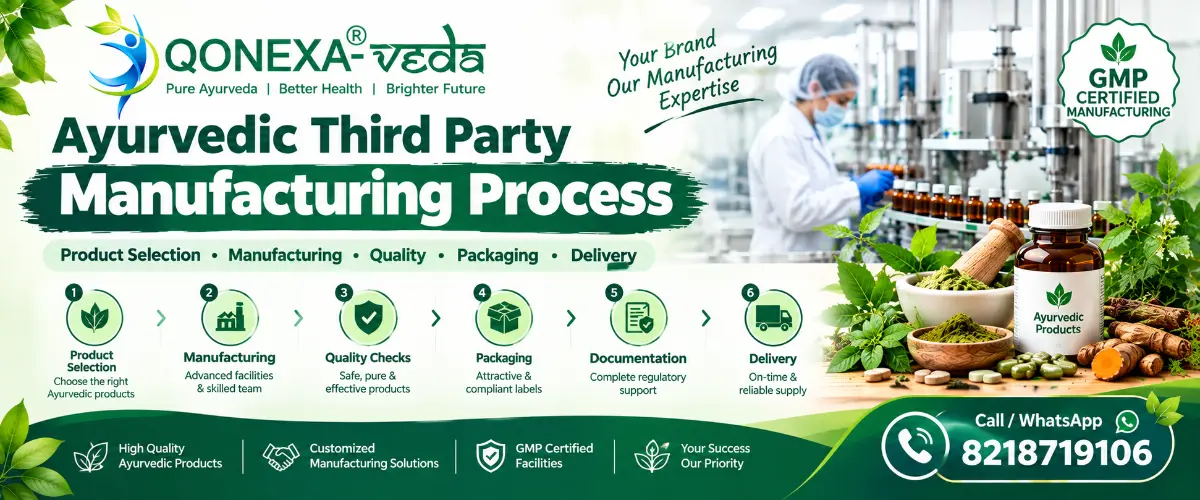
Ayurvedic Third Party Manufacturing Process: Step-by-Step Guide
Understand the complete Ayurvedic third party manufacturing process, from
product selection and manufacturer evaluation to quotation, packaging,
quality checks, production, documentation and final delivery.
Introduction
The Ayurvedic and herbal products market offers opportunities for businesses
that want to develop and market their own product ranges. However, setting up
a complete manufacturing facility requires infrastructure, equipment,
technical resources, quality systems and significant operational planning.
This is where third party manufacturing can be considered. Instead of
establishing an entire production facility, a business can work with an
established manufacturer to produce products according to an agreed
requirement.
Understanding the Ayurvedic Third Party Manufacturing Process
is important before placing your first order. A well-planned process can make
communication easier and help you manage product selection, packaging,
documentation, production and delivery more efficiently.
Quick overview: The process generally moves from requirement
planning → product selection → manufacturer selection → quotation → product
finalization → artwork and packaging → documentation → production → quality
checks → dispatch.
What Is Ayurvedic Third Party Manufacturing?
Ayurvedic third party manufacturing is a business arrangement in which one
company or entrepreneur gets Ayurvedic products manufactured through another
manufacturing company.
The brand owner can focus on product selection, branding, sales, marketing
and distribution, while the manufacturing partner handles the production
activities according to the agreed specifications and applicable requirements.
This model can be useful for startups, distributors, franchise businesses and
established companies looking to expand their product portfolio.
Simple Example
Suppose an entrepreneur wants to launch an Ayurvedic product range under a
new brand. Instead of investing immediately in manufacturing infrastructure,
the entrepreneur can approach a suitable third party manufacturer.
After discussing products, quantities, packaging, pricing and other
requirements, the manufacturer can produce the agreed products under the
applicable arrangement.
Why Choose Ayurvedic Third Party Manufacturing?
There are several reasons businesses explore third party manufacturing.
Lower Infrastructure Requirement
The business does not necessarily need to establish its own complete
manufacturing facility.
Product Expansion
Companies can explore additional products without building manufacturing
capacity for every dosage form.
Focus on Marketing
The business can concentrate more heavily on branding, sales and distribution.
However, third party manufacturing is not simply about finding the cheapest
manufacturer. The suitability of the manufacturer, product quality,
communication, documentation, packaging and commercial terms all matter.
Ayurvedic Third Party Manufacturing Process
The exact workflow can vary between manufacturers and products, but a typical
third party manufacturing process can be divided into the following stages:
1
Requirement Planning
Define your target market, product categories, quantity and business
objectives.
2
Product Selection
Shortlist products based on market demand and your business strategy.
3
Manufacturer Selection
Evaluate manufacturers according to capabilities, quality and commercial
requirements.
4
Quotation
Request pricing, MOQ, packaging and production details.
5
Product Finalization
Finalize products, quantities, packaging and other commercial details.
6
Artwork & Branding
Prepare suitable product artwork, labels and packaging.
7
Documentation
Complete the relevant documentation and approvals required for the product.
8
Production
The manufacturing partner schedules and carries out production.
9
Quality Checks
Applicable quality control procedures are carried out before dispatch.
10
Dispatch
Finished products are packed and dispatched according to agreed terms.
Step 1: Define Your Business Requirement
Before contacting a manufacturer, clearly define what you want to achieve.
This makes discussions more productive and helps manufacturers provide more
relevant information.
Consider These Questions
- What type of Ayurvedic products do you want?
- Who is your target customer?
- Which geographical market will you serve?
- Do you need your own brand?
- What quantity do you initially expect?
- What packaging format do you prefer?
- What is your approximate budget?
- Do you need a complete product range or selected products?
Having these details ready can save time and reduce unnecessary back-and-forth
with manufacturing companies.
Step 2: Select the Right Ayurvedic Products
Product selection is one of the most important stages in the
Ayurvedic Third Party Manufacturing Process.
A manufacturer may have a large catalogue, but that does not mean every
product should be included in your initial range.
Potential Product Categories
- Ayurvedic tablets
- Ayurvedic capsules
- Herbal syrups
- Ayurvedic oils
- Herbal powders
- Wellness formulations
- Personal care products
- Other applicable Ayurvedic and herbal products
Choose products based on market requirements, business positioning,
manufacturer capabilities and applicable product requirements.
A focused product range can make initial inventory management, marketing and
distribution easier than launching a very large catalogue immediately.
Step 3: Find a Suitable Ayurvedic Manufacturer
After identifying your product requirements, the next step is to shortlist
potential manufacturing partners.
What Should You Check?
| Factor |
What to Evaluate |
| Manufacturing Capability |
Whether the manufacturer can produce the required dosage forms and products. |
| Quality Systems |
Relevant quality procedures and controls. |
| Product Range |
Availability of products suitable for your business. |
| MOQ |
Minimum order quantities for selected products. |
| Packaging |
Available packaging and private-label options. |
| Communication |
Responsiveness and clarity during discussions. |
| Production Timeline |
Expected manufacturing and dispatch schedule. |
Do not compare manufacturers on price alone. A suitable manufacturing partner
should be evaluated on the complete business requirement.
Step 4: Request Product Details and Quotation
Once you have shortlisted a manufacturer, request detailed commercial
information for the products you are considering.
Ask for:
- Product name
- Dosage form
- Pack size
- Available packaging
- Minimum order quantity
- Price structure
- Applicable taxes
- Delivery or transportation terms
- Expected production timeline
- Available documentation
Make sure the quotation is understood clearly before you finalize your order.
Ask questions about anything that is unclear.
Step 5: Finalize Products and Quantities
After comparing products and quotations, finalize the products that fit your
business plan.
Avoid selecting products solely because they have the lowest price. Consider
market demand, packaging, positioning, expected sales and inventory
requirements.
Prepare a Product Sheet
| Information |
Example |
| Product |
Selected Ayurvedic Product |
| Pack Size |
As applicable |
| Quantity |
Required order quantity |
| Brand |
Your proposed brand name |
| Packaging |
Bottle / Box / Other |
| Artwork |
Final or pending |
Step 6: Packaging and Branding
If you are launching products under your own brand, packaging becomes an
important part of the manufacturing process.
Branding Elements Can Include:
- Brand logo
- Product name
- Colour scheme
- Label design
- Carton artwork
- Product information
- Applicable declarations
The artwork should be reviewed before final production. Product-specific
labelling requirements should be checked according to applicable rules.
Do not print large quantities of packaging artwork until the relevant details
have been reviewed and finalized.
Step 7: Documentation and Compliance
Documentation is an important component of the
Ayurvedic Third Party Manufacturing Process.
The exact documents required can vary according to the product, manufacturing
arrangement, business structure and applicable regulations.
Discuss Relevant Documentation
- Business documents
- Manufacturer-related documents
- Product-related documents
- Quality documents
- Packaging and label information
- Applicable licences or approvals
- Commercial invoices
- Batch-related information
If you are unsure about regulatory requirements, obtain advice from the
relevant authority or a qualified professional.
Step 8: Production Planning
After the product, quantity, packaging and other requirements are finalized,
the manufacturer can plan production.
Production timing can depend on product availability, raw materials,
packaging materials, artwork approval, manufacturing capacity and other
operational factors.
Before Production Begins
- Confirm product specifications.
- Confirm quantity.
- Confirm packaging.
- Approve artwork.
- Confirm commercial terms.
- Confirm delivery information.
- Confirm any required documentation.
Clear confirmation at this stage can reduce errors later in the process.
Step 9: Quality Checks
Quality control is an important part of manufacturing. The exact testing and
quality procedures depend on the product and manufacturing setup.
Quality Areas May Include:
- Raw material controls
- Manufacturing process controls
- Packaging checks
- Batch identification
- Finished product checks
- Applicable testing procedures
- Storage and handling requirements
Businesses should discuss the applicable quality procedures with the
manufacturer before finalizing the manufacturing arrangement.
Step 10: Final Packing and Dispatch
After production and applicable quality procedures are completed, products
are packed for dispatch.
Before dispatch, confirm the following:
- Product quantity
- Product names
- Packaging condition
- Batch details
- Shipping address
- Invoice details
- Transportation arrangements
Good coordination between the business owner and manufacturer can help make
the dispatch process smoother.
Looking for Ayurvedic Third Party Manufacturing?
Discuss your product requirements, manufacturing needs, private-label
requirements and Ayurvedic business plans with Qonexa Veda.
Investment Factors in Third Party Manufacturing
One common advantage of third party manufacturing is that the business does
not necessarily have to establish its own complete manufacturing
infrastructure.
However, there are still several expenses that should be considered.
Manufacturing Cost
Depends on product, formulation, quantity and manufacturing terms.
Packaging
Includes bottles, cartons, labels and other applicable packaging materials.
Branding
Includes logo, artwork, website and promotional materials.
Marketing
Budget for digital and offline marketing activities.
Logistics
Transportation and distribution costs should be included in planning.
Working Capital
Maintain sufficient funds for recurring business operations.
Common Mistakes to Avoid
1. Choosing a Manufacturer Only on Price
Low pricing should not be the only factor. Manufacturing capability, quality,
communication and documentation also matter.
2. Ordering Too Many Products Initially
Launching too many products can create inventory and marketing challenges.
Start with a focused range where appropriate.
3. Not Checking MOQ
Always understand minimum order quantities before finalizing your product
selection.
4. Ignoring Packaging Requirements
Packaging artwork should be reviewed carefully before production.
5. Not Planning Working Capital
Manufacturing is not the only expense. Marketing, transportation and routine
business costs also require funds.
6. Making Unsupported Product Claims
Avoid unverified health or therapeutic claims in promotional content.
Ayurvedic Third Party Manufacturing Checklist
✓
Business Plan
Define your target market and business objectives.
✓
Product Selection
Shortlist products according to your market.
✓
Manufacturer
Compare suitable manufacturing partners.
✓
Quotation
Confirm pricing, MOQ and commercial terms.
✓
Packaging
Finalize packaging and artwork.
✓
Documentation
Review applicable documents and requirements.
✓
Production
Confirm production schedule.
✓
Quality
Understand applicable quality checks.
✓
Dispatch
Confirm packing, invoice and delivery details.
✓
Marketing
Prepare your market launch strategy.
Qonexa Veda for Ayurvedic Third Party Manufacturing
Qonexa Veda can be explored by businesses looking for Ayurvedic product
manufacturing, third party manufacturing, private label solutions and
Ayurvedic business opportunities.
Before approaching a manufacturer, prepare your product list, expected
quantity, packaging requirements and target market. This can help the
discussion become more specific and efficient.
Explore
Qonexa Veda
for Ayurvedic products and manufacturing-related solutions.
For additional pharmaceutical and healthcare business information, visit
Qonexa.in
.
Final Thoughts
The Ayurvedic Third Party Manufacturing Process becomes much
easier to manage when every stage is planned in advance.
Start with a clear business requirement, select products carefully, compare
manufacturers, understand quotations and MOQs, finalize packaging and
documentation, and then coordinate production and dispatch.
The objective should not simply be to find a manufacturer. It should be to
develop a reliable manufacturing relationship that supports product quality,
consistent supply, branding and long-term business development.
If you are planning to launch an Ayurvedic product range, take time to compare
your options and verify all applicable requirements before making a commercial
commitment.
Frequently Asked Questions
1. What is the Ayurvedic third party manufacturing process?
It generally involves requirement planning, product selection, manufacturer
selection, quotation, product finalization, packaging, documentation,
production, quality checks and final dispatch.
2. Why choose Ayurvedic third party manufacturing?
Third party manufacturing can allow businesses to work with an external
manufacturer instead of establishing their own complete manufacturing
infrastructure, subject to the applicable arrangement and requirements.
3. How do I choose an Ayurvedic third party manufacturer?
Evaluate manufacturing capabilities, product range, quality procedures,
documentation, MOQ, packaging options, communication, pricing and production
timelines.
4. What is MOQ in Ayurvedic third party manufacturing?
MOQ means Minimum Order Quantity. It refers to the minimum quantity that a
manufacturer requires for a particular product or order.
5. Can I manufacture Ayurvedic products under my own brand?
Private label and third party manufacturing arrangements can allow businesses
to develop products under their own brand, depending on the manufacturer,
agreement and applicable requirements.
6. How long does third party manufacturing take?
The timeline varies depending on the product, raw materials, packaging,
artwork approval, quantity, manufacturing schedule and other operational
factors.
7. What products can be manufactured?
Depending on the manufacturer's capabilities, products may include Ayurvedic
tablets, capsules, syrups, oils, powders and other applicable Ayurvedic or
herbal product categories.
8. What documents are required?
Documentation depends on the product, business model, manufacturing
arrangement and applicable requirements. Discuss the required documents with
the manufacturer and relevant professionals.
9. Can Qonexa Veda provide Ayurvedic third party manufacturing?
You can contact Qonexa Veda at 8218719106 to discuss your Ayurvedic product
and third party manufacturing requirements.
10. How can I contact Qonexa Veda?
You can call 8218719106 or contact Qonexa Veda through WhatsApp using the same
number.
Disclaimer: This article is provided for general informational purposes and
does not constitute legal, medical or regulatory advice. Requirements may
vary depending on the product, business model and jurisdiction. Verify
current requirements with the relevant authorities or qualified
professionals.