
Ayurvedic Product Manufacturer in India
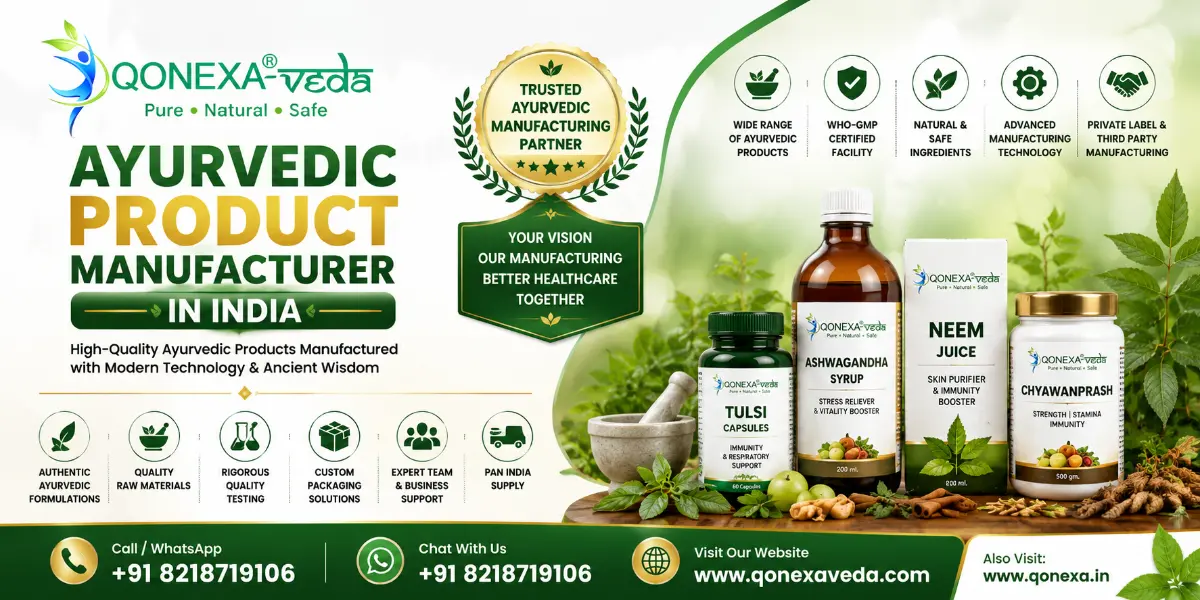
Ayurvedic Product Manufacturer in India – Complete Guide for Businesses
A practical, business-focused guide to selecting a manufacturing partner, developing Ayurvedic products, managing formulations and packaging, understanding quality expectations, and building a reliable herbal healthcare brand in the Indian market.
India has a long-standing tradition of Ayurveda, while modern consumers are increasingly interested in wellness products, herbal formulations and plant-based approaches to everyday healthcare. This combination has created opportunities for entrepreneurs, distributors, pharmacies, healthcare businesses and established companies that want to introduce their own Ayurvedic product ranges.
However, creating a successful Ayurvedic brand involves much more than putting a logo on a bottle. A business needs suitable formulations, dependable manufacturing, compliant packaging, quality-focused processes, product documentation, sensible minimum order quantities, reliable supply and a manufacturing partner who understands commercial requirements. The right partnership can make product development smoother and help a new brand enter the market with confidence.
Why the Ayurvedic Manufacturing Market Is Growing
The Indian wellness market is becoming more diverse. Customers can now find traditional formulations, herbal supplements, personal care products, wellness drinks, oils, syrups, capsules, tablets and other plant-based products through pharmacies, distributors, online marketplaces and direct-to-consumer channels. This creates room for brands with a clear product proposition and dependable supply chain.
For an entrepreneur, manufacturing through a specialized partner can reduce the complexity of establishing production infrastructure. Instead of investing immediately in every piece of equipment, a company can work with an experienced manufacturing facility and focus more attention on brand positioning, distribution, sales, customer education and market development.
At the same time, competition has increased. Customers and channel partners expect attractive packaging, consistent quality, professional communication and dependable availability. Therefore, choosing the right manufacturing partner has become a strategic business decision rather than a simple purchasing decision.
What Does an Ayurvedic Manufacturing Partner Actually Do?
A manufacturing partner can support different stages of a product's journey, depending on the business model and service scope. Some businesses need ready formulations with their own labels. Others need assistance with product selection, formulation development, packaging concepts and a complete private-label solution.
Product Development
Support with selecting suitable product formats, ingredients and commercially practical formulations according to the intended category and target market.
Manufacturing
Production of agreed formulations using defined processes, raw materials, packaging components and quality controls.
Private Label Support
Manufacturing products under the customer's own brand name, subject to the applicable legal and product requirements.
Packaging & Supply
Support for bottles, jars, cartons, labels and other packaging components, followed by dispatch and supply planning.
The exact scope should be confirmed in writing before an order is placed. A professional manufacturer should be able to explain what is included, what the customer must provide, expected timelines, payment terms, packaging responsibilities, quality documentation and the process for approving artwork and samples.
How to Choose the Right Ayurvedic Product Manufacturer in India
The first step is to define your business requirement. Do you want a small starter range, a large product portfolio, private-label manufacturing, custom formulation, herbal personal care products, classical Ayurvedic products, proprietary products or a combination of categories? Once this is clear, you can compare manufacturers against the same checklist.
1. Check the Manufacturer's Product Categories
A manufacturer should have practical experience with the type of products you plan to sell. Ask for a current product list and identify the dosage forms and categories that match your business plan. Depending on the facility, these may include tablets, capsules, syrups, powders, oils, juices, herbal blends and personal care formats.
2. Understand the Manufacturing Capability
Ask how the facility handles raw material procurement, production, processing, filling, packing and batch identification. A capable manufacturer should be able to describe its production workflow clearly rather than giving only a general assurance of quality.
3. Review Quality Systems
Quality should be considered throughout the manufacturing process. Discuss raw material checks, in-process controls, finished-product testing where applicable, batch records, storage conditions and traceability. If a manufacturer presents certifications or approvals, verify their relevance to the facility and the products being manufactured.
4. Ask About Product Documentation
Depending on the product and business model, documentation may include product specifications, invoices, batch information, test reports or other records. Your manufacturer should clearly explain which documents are available and which documents are the customer's responsibility.
5. Compare Minimum Order Quantities
Minimum order quantity can strongly influence the economics of a new brand. A large first order may reduce the unit cost but increase inventory risk. A smaller initial run can help test the market but may carry a higher per-unit cost. Compare the complete landed cost rather than looking at only the quoted manufacturing price.
6. Evaluate Packaging Options
Packaging affects product protection, shelf presentation, logistics and brand perception. Discuss available bottle sizes, jars, cartons, labels, closures and secondary packaging. Confirm whether artwork is supplied by the customer or supported by the manufacturer.
7. Check Communication and Timelines
Manufacturing projects can involve multiple approvals. A manufacturer that communicates clearly about samples, artwork, production scheduling and dispatch can reduce avoidable delays. Before confirming an order, ask for a realistic timeline and identify the stages that depend on your approval.
Private Label Ayurvedic Manufacturing: How It Works
Private label manufacturing allows a business to sell a product under its own brand while production is handled by a manufacturing partner. It can be useful for entrepreneurs who want to build a recognizable brand without establishing a complete manufacturing plant from the beginning.
- Define the brand concept: Decide your target audience, product category, price positioning and distribution model.
- Select products: Shortlist formulations that fit the business objective and applicable category requirements.
- Review specifications: Confirm formulation details, pack size, ingredients, product format and documentation requirements.
- Approve samples: Evaluate the sample product and packaging before moving to commercial production.
- Finalize artwork: Prepare and approve labels, cartons and other printed materials after regulatory review.
- Confirm commercial terms: Agree on quantity, pricing, payment terms, production timeline and dispatch conditions.
- Manufacturing and quality checks: Production is carried out according to the agreed specifications and processes.
- Dispatch: Finished goods are packed and supplied according to the agreed delivery plan.
This process can vary from one project to another. Custom formulations may require additional development work, sampling and approvals compared with an existing formulation.
Popular Ayurvedic Product Formats for New Brands
A diversified product portfolio can help a brand serve different customer needs and price points. The ideal portfolio depends on your target market, regulatory category, distribution network and manufacturing feasibility.
| Product Format | Typical Business Advantage | Important Consideration |
|---|---|---|
| Tablets | Convenient and familiar dosage format | Packaging, formulation and stability requirements |
| Capsules | Easy to position for wellness categories | Ingredient specifications and suitable packaging |
| Syrups | Useful for selected wellness and traditional formulations | Container selection, storage and product specifications |
| Powders | Flexible format for various herbal products | Moisture protection and appropriate packaging |
| Oils | Strong fit for traditional and personal-care categories | Suitable bottle, closure and storage conditions |
| Juices | Popular format in certain wellness categories | Packaging, shelf-life and applicable product requirements |
What Makes a Strong Ayurvedic Brand?
Manufacturing is only one part of the business. A strong Ayurvedic brand combines product quality with clear positioning. Before launching, decide what makes your range different. Your advantage might be a focused product category, a professional packaging system, a specific customer segment, a distributor-friendly portfolio or a strong educational marketing strategy.
Brand consistency is equally important. The logo, color system, packaging style, product names, website, brochures and social media should communicate the same identity. Customers should recognize your brand regardless of where they encounter it.
Formulation and Product Selection: What Businesses Should Consider
Product selection should begin with market demand but should not end there. Consider whether the product fits your target audience, whether the dosage form is practical, whether the ingredients and claims are appropriate, whether the product can be manufactured consistently, and whether the expected selling price can support distribution and marketing costs.
A manufacturer can help explain technical and production considerations, but the brand owner should maintain responsibility for its commercial strategy and ensure that all product claims and marketing communications are appropriate for the applicable regulations.
Start With a Focused Product Range
Launching too many products at once can create inventory and marketing challenges. A focused initial range may be easier to manage. After learning which products receive repeat orders, a business can expand the portfolio based on actual market performance.
Think About Pack Sizes
Pack size influences customer affordability, retailer margins, logistics and repeat purchase behavior. Compare multiple pack-size options where commercially sensible, and calculate the complete cost of each configuration.
Build a Consistent Range
Products that look unrelated can make a new brand appear fragmented. A consistent label architecture and packaging system can create a more professional shelf presence and make future product additions easier.
Quality and Manufacturing Standards
Quality should not be treated as a marketing phrase. It is a system involving raw materials, people, equipment, processes, documentation, testing where applicable, storage and traceability. A prospective manufacturing partner should be willing to explain its quality approach in understandable terms.
When evaluating a facility, ask about incoming material controls, batch identification, production records, cleaning procedures, storage conditions and finished-product checks. If the manufacturer holds certifications, ask for details relevant to your project instead of assuming that one certification automatically covers every product category or claim.
Packaging and Labeling for Ayurvedic Product Manufacturer in India Projects
Packaging serves three major functions: protecting the product, communicating essential information and presenting the brand. A visually attractive label is useful, but it should never come at the expense of required information or readability.
Before printing, the business should have the artwork reviewed against the requirements applicable to its product category. Check product name, ingredients, net quantity, batch information, manufacturing details, dates, storage information, directions and other required declarations as relevant to the product.
Do not make exaggerated or unsupported medical claims simply because a marketing phrase sounds attractive. Product communication should be truthful, appropriately supported and suitable for the regulatory category.
Cost Factors When Working With an Ayurvedic Product Manufacturer in India
Manufacturing price is influenced by many variables. These can include formulation, raw materials, dosage form, quantity, packaging components, printed materials, testing, development work, freight and other project-specific requirements.
For a realistic business calculation, create a simple product costing sheet. Include manufacturing cost, packaging, transport, taxes where applicable, distributor or retailer margins, marketing expenses, payment processing costs and expected wastage or returns. This will give you a better picture of the actual commercial opportunity.
Why the Cheapest Quote May Not Be the Best Quote
A lower quotation can sometimes come with limitations in packaging, communication, minimum quantities, development support or delivery flexibility. Compare manufacturers using a complete scorecard: quality, product fit, documentation, price, MOQ, packaging, timeline and after-sales support.
How QONEXA Veda Can Support Ayurvedic Brand Development
QONEXA Veda is positioned to support businesses that want to develop and market Ayurvedic and herbal product ranges. The goal is to make the manufacturing journey more organized, from product selection and manufacturing discussions to packaging and supply planning.
For businesses exploring an Ayurvedic Product Manufacturer in India, the practical approach is to first share your product requirements, target quantity, preferred dosage forms and brand objectives. This allows the manufacturing discussion to focus on the actual project instead of a generic product list.
Depending on the requirement, businesses can explore ready product ranges, private-label opportunities, packaging options and manufacturing support. Every project should be evaluated individually because product category, quantity, formulation and documentation requirements can differ.
Wide Product Selection
Explore multiple Ayurvedic and herbal product formats for different business models and customer segments.
Private Label Support
Develop products under your own brand identity with packaging and manufacturing coordination.
Business-Focused Guidance
Discuss product quantity, pack sizes, portfolio planning and practical launch requirements.
Supply Coordination
Plan production and dispatch according to the approved product and packaging specifications.
Questions to Ask Before Finalizing a Manufacturer
Before placing an order, prepare a written checklist. The following questions can help you compare different manufacturers objectively:
- Which product categories and dosage forms do you manufacture?
- Can you provide the relevant facility and product documentation?
- What is the minimum order quantity for each product?
- What packaging options are available?
- Can you support private-label branding?
- How are samples approved before commercial production?
- What is the expected manufacturing timeline?
- Which documents will be supplied with the finished goods?
- How are batch details and product traceability maintained?
- What are the payment and dispatch terms?
Common Mistakes Businesses Make
Choosing Only on Price
Price matters, but it should be evaluated together with quality, quantity, packaging, service and delivery reliability.
Ordering Too Much Too Early
A large inventory can tie up capital. New brands should carefully estimate demand and cash flow before committing to large quantities.
Ignoring Packaging Costs
Packaging can materially affect the final unit economics. Include bottles, caps, labels, cartons, printing and transport in your calculations.
Using Unsupported Claims
Marketing language can create regulatory and reputational problems if it promises guaranteed treatment or makes claims that are not appropriate for the product category. Keep communications accurate and responsible.
Skipping Sample Approval
A sample provides an opportunity to evaluate the product and packaging before a commercial batch. Do not treat sample approval as an unnecessary step.
Failing to Plan Reorders
A product that sells quickly is only valuable if you can maintain supply. Track inventory and communicate reorder requirements before stock becomes critical.
How to Launch Your Own Ayurvedic Brand Step by Step
- Research your market: Identify your customer, sales channel, competitors and price range.
- Select a niche: Choose a focused category instead of trying to serve everyone.
- Create your product list: Start with a manageable number of SKUs.
- Shortlist manufacturers: Compare capability, quality approach, MOQ, packaging and support.
- Review samples: Confirm product and packaging before production.
- Build the brand identity: Finalize logo, label system, website and marketing assets.
- Prepare your sales channel: Set up distributors, retailers, online channels or a direct sales system.
- Launch with education: Explain the product category and appropriate usage information clearly.
- Track sales: Measure repeat purchases, customer feedback and product-level performance.
- Scale carefully: Add products and increase production based on market evidence.
Why Long-Term Manufacturing Partnerships Matter
A one-time order may solve an immediate requirement, but a long-term manufacturing relationship can be more valuable. As a brand grows, it may need additional SKUs, revised packaging, larger quantities, improved forecasting and faster coordination.
A stable manufacturing relationship also helps the brand create consistent product specifications and repeat-order processes. Over time, the manufacturer can better understand the business's preferred pack sizes, packaging style and production cycle.
For this reason, entrepreneurs should evaluate not only whether a manufacturer can make the first order, but also whether the manufacturer can support the business as demand increases.
Digital Marketing for an Ayurvedic Brand
Manufacturing creates the product, but marketing creates awareness. A modern Ayurvedic brand should build a professional online presence with a clear website, informative product pages, educational articles, social media content and direct communication options.
Content marketing can be especially useful because customers often have questions about product categories, ingredients, usage, packaging, manufacturing and brand authenticity. Helpful educational content can support organic visibility while also building trust.
However, content should remain factual and responsible. Avoid presenting general wellness information as a guaranteed medical outcome. Product-specific claims should be checked against the applicable requirements before publication.
Internal Business Resources
If you are planning a broader healthcare or pharmaceutical business, you can also explore the resources and business information available through QONEXA Lifecare. Use the resources that are relevant to your business model, and always confirm the current service scope before making a commercial decision.
Final Checklist Before You Place Your First Manufacturing Order
| Area | What to Confirm |
|---|---|
| Product | Formulation, dosage form, pack size and specifications |
| Quality | Relevant quality systems, testing and traceability information |
| Packaging | Bottle/jar, cap, label, carton and artwork responsibilities |
| Quantity | MOQ, production quantity and reorder planning |
| Commercials | Pricing, taxes where applicable, payment and freight terms |
| Timeline | Sample, artwork, production and dispatch stages |
| Documentation | Applicable invoices, batch details and product records |
| Marketing | Website, product content and compliant communication plan |
Conclusion
Building an Ayurvedic brand can be an attractive business opportunity when product selection, manufacturing, quality, packaging, pricing and marketing are planned together. The manufacturing partner you choose can influence your product consistency, launch timeline, inventory planning and ability to scale.
The best approach is to compare manufacturers carefully, ask detailed questions, approve samples, understand the commercial terms and maintain clear product records. Instead of focusing on one factor such as the lowest price, evaluate the complete partnership.
If your objective is to develop an Ayurvedic product range under your own business identity, QONEXA Veda can be approached to discuss product requirements, manufacturing options, private-label possibilities and supply planning. Share your expected product category, quantity and business model so that the discussion can be based on your actual requirement.
Ready to Discuss Your Ayurvedic Product Range?
Talk to QONEXA Veda about Ayurvedic manufacturing, private-label products and brand development support.
📞 Call: +91 8218719106 💬 WhatsApp Us 🌿 Visit QONEXA VedaFrequently Asked Questions
What should I look for in an Ayurvedic manufacturer?
Look at manufacturing capability, relevant quality systems, product categories, documentation, MOQ, packaging options, sample approval, production timelines, communication and long-term supply support. A manufacturer should be evaluated on the complete business requirement rather than price alone.
Can I launch Ayurvedic products under my own brand?
Private-label manufacturing can allow businesses to market products under their own brand, subject to the applicable product category, legal, labeling and regulatory requirements. Discuss your proposed brand and product range with the manufacturer before finalizing the project.
What products can an Ayurvedic manufacturer produce?
Depending on the facility, product formats may include tablets, capsules, syrups, powders, oils, juices and other Ayurvedic or herbal formats. The exact range should be confirmed with the manufacturer because manufacturing capabilities differ.
Is private-label manufacturing suitable for a new business?
It can be suitable when a new business wants to build its own brand without establishing a complete manufacturing infrastructure immediately. The business should still plan its product strategy, inventory, marketing, documentation and cash flow carefully.
How much quantity should I order for a new Ayurvedic brand?
There is no universal quantity. The right order depends on the product, MOQ, expected demand, shelf-life considerations, available working capital and distribution network. Starting with a manageable range can help reduce inventory risk while the market is being tested.
Can the manufacturer help with packaging?
Many manufacturing partners can support packaging components such as bottles, jars, labels and cartons. Confirm exactly which components are available, who provides the artwork, who approves the final design and what packaging costs are included in the quotation.
Why is sample approval important?
Sample approval gives the brand an opportunity to review the product and packaging before commercial production. It can help identify specification, appearance, pack-size or artwork issues early in the process.
How can I contact QONEXA Veda?
You can call or WhatsApp QONEXA Veda at +91 8218719106 or visit the official website at qonexaveda.com to discuss your product manufacturing requirement.